




1. The pH Revolution in Food & Agriculture
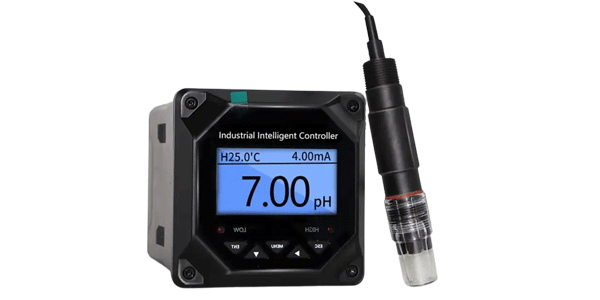
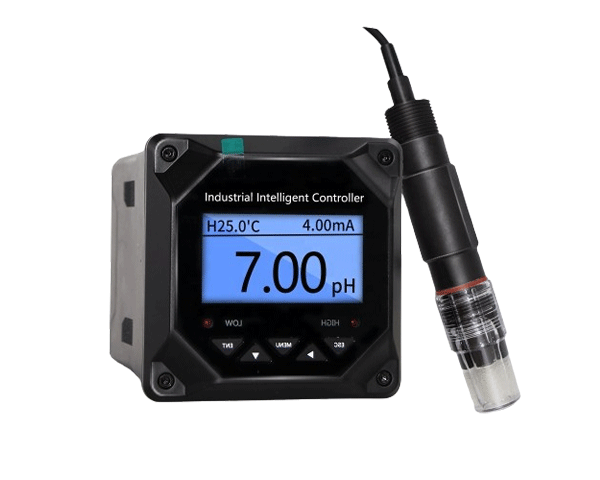
pH measurement has evolved from a simple quality check to a sophisticated tool driving innovation across the food supply chain—from soil to harvest, through processing to packaging. Today, real-time pH monitoring powered by IoT sensors and AI analytics is transforming how we grow, process, and preserve food.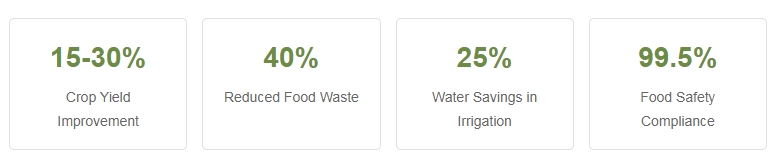
The global market for pH sensors in food and agriculture is projected to reach $2.8 billion by 2028, driven by precision agriculture adoption, food safety regulations, and consumer demand for quality assurance. This guide explores the most innovative applications transforming the industry.
pH affects everything from nutrient availability in soil (optimal range 6.0-7.0 for most crops) to microbial growth in food (pathogens thrive at pH 4.6-7.5). Control at every stage is critical for safety and quality.
2. Precision Agriculture: Soil pH Management
Innovation: GPS-guided soil pH mapping enables site-specific lime application
Impact: Reduces lime usage by 20-40% while optimizing soil pH across fields
Technology: Soil pH sensors on tractors provide real-time data for variable-rate application
Innovation: Automated fertigation systems adjust irrigation water pH to optimize nutrient uptake
Impact: 15-25% improvement in fertilizer efficiency, reduced runoff
Technology: Inline pH sensors with automatic acid injection
Innovation: Wireless sensor networks provide continuous soil pH data via IoT
Impact: Early detection of acidification trends, reduced manual sampling
Technology: Solar-powered sensors with LoRaWAN/4G transmission
2.1 Optimal pH Ranges for Major Crops
Case Study: Precision Liming in Iowa — A 5,000-acre corn-soybean farm implemented variable-rate liming based on grid soil sampling (2.5-acre grid). Results: 35% reduction in lime usage, $18/acre savings, and 8 bushel/acre yield increase in previously acidic zones.
3. Food Processing & Safety Innovation
3.1 Hurdle Technology & Pathogen Control
pH is a critical "hurdle" in food preservation. The combination of pH control with other barriers (temperature, water activity) creates multiple obstacles for microbial growth.
| Food Product | Critical pH | Pathogen Control | Innovation |
|---|---|---|---|
| Canned vegetables | ≤4.6 (acidified) | Prevents Clostridium botulinum | Online pH monitoring in retort |
| Fermented dairy | 4.0-4.6 | Controls spoilage organisms | Real-time fermentation pH control |
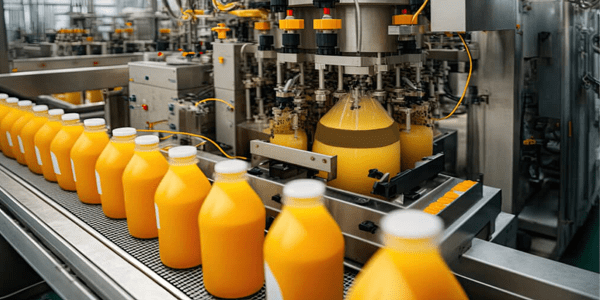
| Fruit juices | ≤4.2 Inhibits Salmonella, E. coli | Inline pH sensors for blending | |
| Pickled vegetables | 3.3-3.8 | Listeria inhibition | Automated acid injection systems |
3.2 Smart Fermentation Control
Fermentation processes across food production—yogurt, cheese, beer, wine, bread, kimchi, kombucha—rely on precise pH monitoring for quality, consistency, and safety.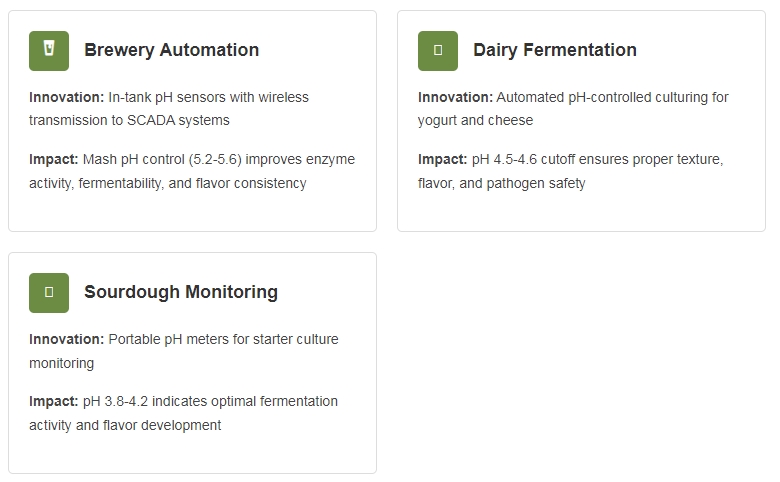
Innovation Spotlight: AI-Powered Fermentation — Smart fermentation vessels use pH sensors with machine learning algorithms to predict optimal fermentation endpoints, reducing batch time by 15-20% while improving consistency.
4. Fresh Produce Quality & Shelf Life
4.1 Post-Harvest pH Management
pH monitoring extends beyond processing to fresh produce quality assessment and shelf-life prediction.
| Application | pH Parameter | Quality Indicator | Benefit |
|---|---|---|---|
| Tomato ripeness | pH 4.0-4.6 | Lower pH = riper fruit | Harvest timing optimization |
| Citrus juice quality | pH 2.5-4.0 (variety dependent) | Low pH indicates proper acidity | Juice blending consistency |
| Meat freshness | pH 5.4-5.8 (fresh), >6.0 (spoiled) | pH increase indicates bacterial growth | Shelf-life prediction, safety screening |
| Fish spoilage detection | pH <6.5 (fresh), >6.8 (spoiled) | pH rise correlates with TMA production | Rapid quality assessment |
Case Study: Non-Destructive pH Sensing — Researchers have developed portable near-infrared (NIR) spectroscopy devices that predict pH of intact fruits without puncture testing, enabling 100% quality screening on packing lines.
5. Hydroponics & Controlled Environment Agriculture
Hydroponic and vertical farming operations depend entirely on precise nutrient solution pH management. pH 5.5-6.5 is optimal for most hydroponic crops.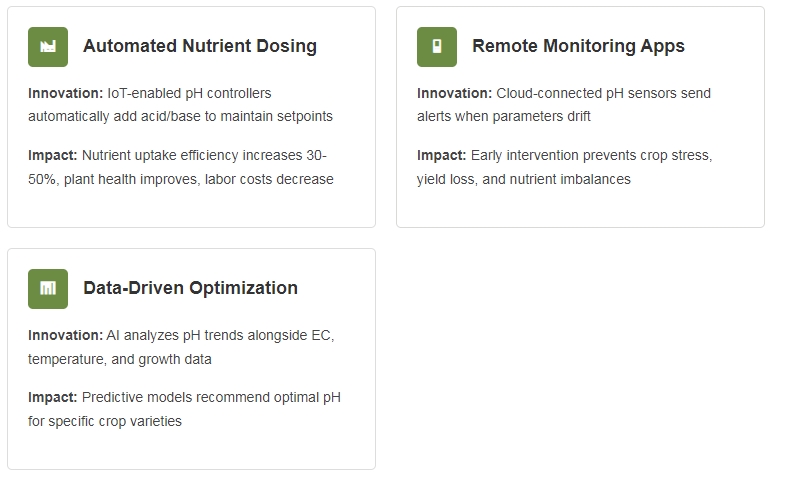
5.1 Hydroponic Crop pH Requirements
Innovation Spotlight: Self-Calibrating pH Sensors — New solid-state ISFET sensors eliminate glass breakage and require no calibration for months, ideal for commercial hydroponic operations where reliability is critical.
6. Food Safety & Regulatory Compliance
6.1 Acidified Foods Regulations
FDA regulations require acidified foods (pH ≤4.6) to be processed under specific controls. pH monitoring is mandatory for compliance with 21 CFR Part 114.
| Regulatory Requirement | pH Specification | Monitoring Frequency |
|---|---|---|
| Equilibrium pH of finished product | ≤4.6 | Every batch |
| In-process pH monitoring | ≤4.6 (after equilibration) | Continuous or frequent |
| Calibrated pH meter accuracy | ±0.05 pH | Daily calibration check |
| Record retention | All pH measurements | Minimum 2 years |
6.2 HACCP Critical Control Points
pH is a CCP in many food processes:
- Thermal processing: pH determines required retort temperature/time (low-acid vs. acidified)
- Fermentation: pH indicates endpoint and safety (e.g., yogurt pH 4.6, sauerkraut pH 3.4-3.6)
- Curing: Meat pH affects nitrite effectiveness and pathogen control
- Marination: pH affects antimicrobial efficacy and texture
Case Study: Blockchain pH Tracking — A major food processor implemented blockchain-enabled pH sensors that record every measurement on an immutable ledger. Audits that once took weeks now take hours, with full traceability from raw material to finished product.
7. Emerging Technologies & Future Trends
7.1 Smart Packaging with pH Indicators
Intelligent packaging incorporating pH-sensitive dyes changes color when food spoils, providing real-time freshness indication to consumers.
- Meat and fish packaging with pH indicators that turn from green to yellow as pH rises
- Milk cartons with color-coded freshness indicators
- Seafood tags that indicate cumulative temperature abuse
7.2 Nanosensors for In-Plant Monitoring
Emerging nanotechnology enables:
- Wireless nanosensors embedded in food during processing
- Real-time pH mapping inside fermenters and storage tanks
- Non-invasive measurement through packaging materials
7.3 AI-Powered Predictive Models
Machine learning algorithms trained on historical pH data can:
- Predict optimal harvest windows based on fruit pH trends
- Forecast fermentation endpoints with 95% accuracy
- Alert operators to emerging contamination before product is affected
The Future: By 2030, integrated pH monitoring systems will connect farm to fork, providing real-time quality data to all supply chain participants—from growers to retailers to consumers—reducing food waste by an estimated 40% globally.
8. Economic Impact & ROI Analysis
| Application | Investment | Annual Savings/Benefit | Payback Period |
|---|---|---|---|
| Precision soil pH mapping | $5-15/acre (sampling + lime) | $20-40/acre (yield increase + lime savings) | 1-2 seasons |
| Automated hydroponic pH control | $500-2,000 per system | $2,000-10,000/year (yield + labor + nutrient savings) | 3-6 months |
| In-line food processing pH | $3,000-15,000 per line | $20,000-100,000/year (reduced waste + compliance + labor) | 6-12 months |
| Fermentation pH automation | $2,000-8,000 per vessel | $15,000-50,000/year (reduced cycle time + consistency + yield) | 4-8 months |
Studies across 500 farms and food processors show that investment in advanced pH monitoring technology delivers an average ROI of 200-400% over 3 years, with payback typically achieved within 6-12 months.
9. Implementation Best Practices
9.1 For Agriculture
- Establish baseline soil pH with grid sampling (2.5-5 acre grids)
- Calibrate soil pH sensors annually against laboratory analysis
- Monitor pH at multiple depths (surface and root zone)
- Integrate pH data with yield maps and variable-rate application equipment
9.2 For Food Processing
- Install redundant pH sensors at critical control points
- Implement automated calibration verification daily
- Integrate pH data into HACCP record-keeping systems
- Use ATC (automatic temperature compensation) for accurate readings
Success Factor: Companies that achieved the highest ROI from pH monitoring integrated the data into their existing ERP or MES systems, enabling automated reporting, trend analysis, and predictive alerts.
10. Frequently Asked Questions
Q: How often should soil pH be tested in precision agriculture?
A: For annual crops, test every 2-3 years. For perennial crops (orchards, vineyards), test every 3-5 years. After liming, retest after 6-12 months to verify adjustment.
Q: What's the optimal pH for most hydroponic crops?
A: 5.5-6.5. Different crops have specific preferences, but most leafy greens and herbs thrive in this range.
Q: How does pH affect food safety?
A: Pathogenic bacteria cannot grow below pH 4.6 (Clostridium botulinum) or 3.7-4.0 (most others). Acidified foods with pH ≤4.6 do not require thermal processing for pathogen control.
Q: Can pH sensors be used in high-temperature food processing?
A: Yes. Specialized high-temperature pH sensors operate up to 130°C (266°F), suitable for retort and sterilization monitoring.
Q: What's the cost of a precision agriculture pH system?
A: Basic soil pH meters: $50-200. Advanced variable-rate liming systems (with GPS and software): $5,000-20,000 for equipment plus $5-15/acre for sampling.
11. Summary: The pH-Powered Future
Key Takeaways:
- pH optimization increases crop yields by 15-30% while reducing input costs
- Real-time pH monitoring reduces food waste by up to 40% through better quality control
- Automated pH systems deliver ROI of 200-400% with payback in 6-12 months
- Emerging technologies (smart packaging, nanosensors, AI) will further transform the industry
- Integration of pH data across the supply chain enables unprecedented traceability and quality assurance
From the soil to the supermarket shelf, pH is the invisible force shaping food quality, safety, and sustainability. The innovations described in this guide represent just the beginning. As sensor technology continues to advance and data analytics become more sophisticated, pH monitoring will play an increasingly central role in feeding the world's growing population safely and sustainably.
The Next Frontier: The integration of pH sensors with blockchain technology, digital twins, and AI decision support systems will create fully transparent, self-optimizing food systems that minimize waste, maximize yield, and ensure safety from seed to plate.