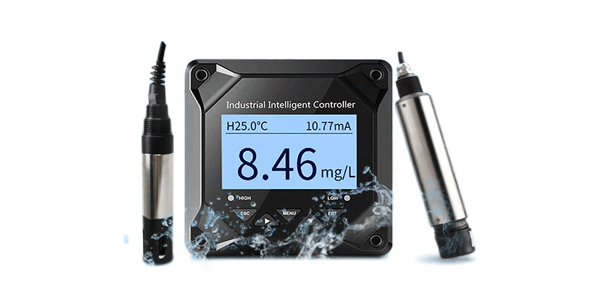
Accurate DO data is non-negotiable for aquaculture health and wastewater process control. Master calibration frequency, correct procedure, and verification to avoid costly errors.
Uncalibrated or poorly calibrated DO sensors can drift up to ±0.5 mg/L within weeks — enough to cause fish stress or wasted aeration energy. The three pillars below ensure your meter stays trustworthy.
How often? Depends on sensor type and environment:
Two-point calibration: Air (100% saturation) and Zero (0% DO) is gold standard.
After calibration, verify with a known standard (e.g., air-saturated water at known temperature). Track calibration history:
| Parameter | Optical (Fluorescence) DO Sensor | Polarographic (Clark cell) Sensor |
|---|---|---|
| Calibration frequency | Every 3–6 months (stable) | Every 2–4 weeks (electrolyte degrades) |
| Zero calibration needed? | Factory zero stable, optional field zero | Required regularly (sodium sulfite or nitrogen) |
| Air calibration method | Clean & dry sensor, point to air, wait for stable reading | Clean membrane, moist sponge in calibration chamber, ensure 100% humidity |
| Maintenance between cal | Wipe optical cap, avoid scratches | Replace membrane & electrolyte solution, polish anode |
| Common drift signs | Slow response or offset >0.3 mg/L | Fluctuating readings, long stabilization time |
During air calibration, droplets cause false low readings. → Gently dry with soft tissue.
Sensor and calibration solution must be at same temp. → Wait 10 min after power on.
Old electrolyte = slow response. → Change every 1-2 months.
Scratches cause light interference. → Use soft cloth; replace cap every 1-2 years.
Unverified calibration may be invalid. → Always test in air-saturated water.
Q1: Can I calibrate my DO meter in water instead of air?
A: Air calibration is the gold standard because air has known oxygen concentration (20.95% O2). Water-based calibration is less accurate due to varying salinity and pressure. Use air calibration whenever possible.
Q2: My optical DO meter shows drift after 4 months — is it broken?
A: Not necessarily. Optical sensors drift slightly over time. Recalibrate and check slope. If slope is still within 90-110% of factory value, sensor is fine. If not, replace the optical cap.
Q3: Do I need to perform zero calibration for an optical sensor?
A: Most modern optical sensors have a stable factory zero that rarely changes. Zero calibration is not mandatory unless you suspect severe contamination or sensor damage. Single-point air calibration is sufficient for typical applications.
Q4: How to store DO sensor after calibration?
A: Optical sensors: store dry with protective cap. Polarographic: keep membrane moist (storage solution or wet sponge) to prevent electrolyte drying/crystallization.
✔️ Schedule calibration based on your sensor type (optical: quarterly, polarographic: monthly).
✔️ Follow the right procedure – air calibration always, zero only when required.
✔️ Validate and log every calibration to track sensor health and guarantee process reliability.
A well-calibrated DO meter is your most valuable water quality insurance.
Compare traditional polarographic electrode vs optical fluorescence DO meters for long-term monitoring in aquaculture and wastewater. Maintenance, accuracy, lifespan, total cost of ownership.
Troubleshoot dissolved oxygen meter issues: slow response, erratic drift, calibration failure. Step-by-step diagnosis for optical and polarographic DO sensors. Field guide with quick fixes.
Extend dissolved oxygen probe lifespan with 5 proven tips: membrane replacement, electrolyte care, cleaning, storage, and handling. Optimize DO sensor performance for aquaculture and wastewater.
Rm. 1208, Building B, Huixin IBC, No. 1 Zhang Bayi Road, High-tech Zone, Xi'an, Shaanxi, China
Copyright © Xi'an Gavin Electronic Technology Co., Ltd Site Map