Temperature Sensors in Renewable Energy: Overheat Prevention for Solar, Wind & Energy Storage Systems
DATE: 2026.07.22 AUTHOR: New Energy Technology Team VIEWS: 3,300+ Temperature Sensors Renewable Energy Solar PV Wind Power Battery Storage Overheat Protection
How temperature sensors protect photovoltaic, wind power, and battery energy storage systems from overheating, ensuring safety, efficiency, and longevity in renewable energy applications
The global transition to renewable energy depends on the reliable performance of solar photovoltaic (PV) systems, wind turbines, and battery energy storage systems (BESS). All of these technologies generate heat during operation, and excessive temperature is one of the leading causes of efficiency loss, accelerated aging, and catastrophic failures — including fires in lithium-ion battery storage. Temperature sensors are therefore essential components in renewable energy systems, providing the data needed to monitor, control, and protect critical equipment.
1. Why Temperature Monitoring is Critical in Renewable Energy
Temperature affects nearly every aspect of renewable energy system performance:
-
Efficiency: Solar panel efficiency drops 0.3-0.5% per °C above 25°C; battery capacity and cycle life degrade at high temperatures
-
Safety: Thermal runaway in lithium-ion batteries can cause fires and explosions
-
Longevity: Every 10°C increase above rated temperature can halve the life of electronic components
-
Reliability: Overheating causes premature failures of inverters, generators, and power electronics
-
Warranty compliance: Manufacturers require documented temperature monitoring for warranty validation
Key Insight: A 10°C rise in operating temperature can reduce the lifespan of power electronics by 50%. Temperature monitoring is not optional — it is essential for safe, efficient, and cost-effective renewable energy operation.
2. Solar Photovoltaic (PV) System Temperature Monitoring
2.1 Key Monitoring Points
PV Panels
Solar Module Temperature
-
Backsheet temperature monitoring
-
Hot spot detection (cell defects)
-
Efficiency correlation with temperature
-
Typical alert threshold: 70-85°C
Inverters
Inverter & Power Electronics
-
IGBT module temperature
-
Heat sink temperature
-
Cabinet ambient temperature
-
Typical alert threshold: 70-80°C
Combiner Boxes
DC Combiner Boxes
-
Terminal and busbar temperature
-
Fuse and breaker temperature
-
Detect loose connections (hot spots)
Cables
DC Cables & Connectors
-
Cable joint temperature
-
Connector temperature (MC4)
-
Prevent fire risk from loose connections
2.2 Recommended Sensor Types
|
Location
|
Sensor Type
|
Temperature Range
|
Accuracy
|
|
PV module backsheet
|
PT100 / PT1000 RTD
|
-40 to +120°C
|
±0.5°C
|
|
Inverter IGBT
|
NTC thermistor / RTD
|
-40 to +150°C
|
±1°C
|
|
Cabinet ambient
|
Digital sensor (SHT31, DS18B20)
|
-40 to +125°C
|
±0.5°C
|
|
DC connectors
|
PT100 surface probe
|
-50 to +200°C
|
±1°C
|
3. Wind Power System Temperature Monitoring
3.1 Key Monitoring Points
Generator
Wind Turbine Generator
-
Stator winding temperature (embedded PT100)
-
Bearing temperature
-
Rotor temperature
-
Typical alert: 130-155°C (insulation class dependent)
Gearbox
Gearbox & Bearings
-
Oil temperature
-
Bearing temperature
-
Typical alert: 70-85°C
Converter
Power Converter
-
IGBT module temperature
-
Coolant temperature
-
Cabinet temperature
Transformer
Transformer & Switchgear
-
Winding temperature
-
Oil temperature
-
Ambient temperature
3.2 Wind Turbine Temperature Monitoring Challenges
-
Remote locations: Sensors must be reliable and low-maintenance
-
Harsh environments: Vibration, temperature extremes, humidity
-
Rotating equipment: Slip rings or wireless transmission for sensor signals
-
Safety: Temperature monitoring prevents fires in nacelle
4. Battery Energy Storage System (BESS) Temperature Monitoring
4.1 The Critical Role of Temperature in Battery Safety
Lithium-ion battery temperature monitoring is perhaps the most safety-critical application in renewable energy:
-
Thermal runaway: Above ~80°C, exothermic reactions can cause uncontrollable temperature rise and fire
-
Performance: Optimal operating range is 15-35°C
-
Lifespan: High temperatures accelerate capacity fade
-
Charging safety: Charging below 0°C or above 45°C can cause lithium plating or thermal events
4.2 BESS Monitoring Points
|
Level
|
Monitoring Points
|
Typical Alert Threshold
|
|
Cell Level
|
Individual cell surface temperature
|
55-60°C (warning), 70°C (critical)
|
|
Module Level
|
Module surface temperature
|
55°C (warning), 65°C (critical)
|
|
Rack Level
|
Rack ambient, busbar temperature
|
50°C (warning), 60°C (critical)
|
|
Container Level
|
Container ambient, HVAC status
|
40°C (warning), 45°C (critical)
|
|
Power Electronics
|
PCS (Power Conversion System) temperature
|
70°C (warning), 80°C (critical)
|
Safety Note: Battery energy storage systems must have redundant temperature monitoring with automatic shutdown capability. NFPA 855 and UL 9540A standards require temperature monitoring as part of fire prevention strategy.
5. Transmission Line & Cable Temperature Monitoring
-
Overhead transmission lines: Conductor temperature affects sag and current-carrying capacity (ampacity)
-
Dynamic line rating: Real-time temperature data allows increased line capacity without exceeding limits
-
Underground cables: Cable joint temperature monitoring prevents failures
-
Substation equipment: Transformer, breaker, and busbar temperature monitoring
5.1 Technologies for Transmission Line Monitoring
|
Technology
|
Application
|
Advantages
|
|
Distributed Temperature Sensing (DTS)
|
Fiber optic cable along transmission lines
|
Continuous measurement, no sensors needed, long distance
|
|
Surface Acoustic Wave (SAW) sensors
|
Conductor temperature
|
Passive, wireless, no power needed
|
|
Infrared thermal imaging
|
Periodic inspection
|
Detects hot spots across large areas
|
|
Wireless sensor networks
|
Specific monitoring points
|
Real-time data, easy installation
|
6. Temperature Sensor Technologies for Renewable Energy
|
Sensor Type
|
Range
|
Accuracy
|
Best For
|
|
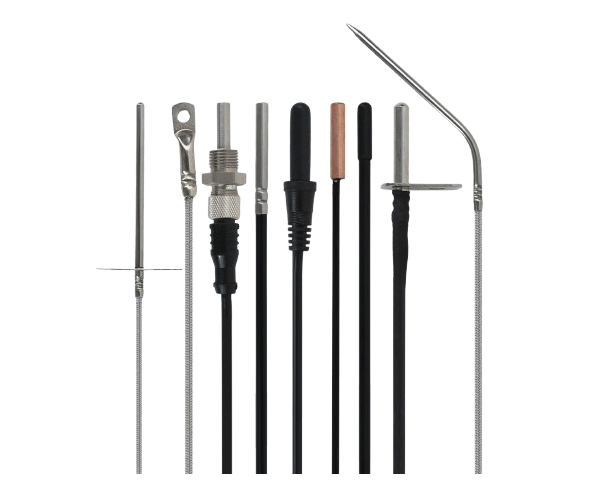
PT100 / PT1000 (RTD)
|
-200 to +850°C
|
±0.1 to ±0.5°C
|
Generator windings, transformers, high-accuracy applications
|
|
NTC Thermistor
|
-50 to +150°C
|
±0.2 to ±0.5°C
|
Inverters, power electronics, battery cells
|
|
Thermocouple (Type K, J, T)
|
-200 to +1200°C
|
±0.5 to ±2°C
|
High-temperature applications (exhaust, process)
|
|
Digital (DS18B20, SHT31, BME280)
|
-55 to +125°C
|
±0.2 to ±0.5°C
|
Ambient monitoring, cabinet temperature, low-cost multi-point
|
|
Fiber Optic (DTS)
|
-40 to +300°C
|
±0.5 to ±1°C
|
Transmission lines, large area monitoring
|
|
Infrared (Non-contact)
|
-50 to +1000°C
|
±1 to ±2%
|
Moving equipment, high-voltage components
|
7. System Architecture & Communication
7.1 Typical Monitoring Architecture
-
Sensors: Installed at critical points (cells, inverters, generators, cables)
-
Data Acquisition: RTUs or PLCs collect sensor data
-
Communication: Modbus, CAN bus, Ethernet, or wireless (LoRa, 4G/5G)
-
Monitoring Platform: SCADA, EMS (Energy Management System), or cloud platform
-
Alarms & Control: Automated alerts and shutdown commands
7.2 Communication Protocols
-
Modbus RTU/TCP: Common for industrial sensors and RTUs
-
CAN bus: Used in BESS for battery management system (BMS) communication
-
LoRaWAN / NB-IoT: For remote solar farms and wind turbines
-
4G/5G: For real-time data and video transmission
-
IEC 61850: For substation automation and protection
8. Alarm & Protection Strategies
8.1 Tiered Alarm Strategy
|
Level
|
Condition
|
Action
|
|
Level 1 — Warning
|
Temperature 10°C below critical
|
Notify operator, increase cooling, log event
|
|
Level 2 — Alert
|
Temperature 5°C below critical
|
Reduce power output, activate backup cooling
|
|
Level 3 — Critical
|
Temperature reaches critical threshold
|
Reduce load or shut down equipment, activate fire suppression (BESS)
|
|
Level 4 — Emergency
|
Temperature exceeds safe limit
|
Emergency shutdown, evacuate area, notify fire department
|
8.2 BESS-Specific Protection
-
Cell-level monitoring: Every cell or group of cells monitored
-
Redundant sensors: Multiple sensors per module for reliability
-
Automatic HVAC control: Cooling activated based on temperature
-
Fire suppression interface: Temperature alarm triggers fire suppression system
-
Emergency ventilation: Prevents gas accumulation in case of cell venting
9. Case Studies
Case 1: Large-Scale Solar Farm — Hot Spot Detection
A 100 MW solar farm installed temperature sensors on PV module backsheets and DC combiner boxes. The monitoring system detected a 15°C temperature rise in one combiner box compared to others. Investigation revealed a loose connection causing increased resistance. The issue was corrected before it caused a fire. The system also identified underperforming modules due to hot spots, enabling targeted maintenance and recovering 3% of lost generation.
Case 2: Wind Farm — Generator Bearing Failure Prevention
A wind farm operator installed PT100 temperature sensors on generator bearings and gearbox oil in 40 turbines. The system detected a gradual temperature rise in one turbine's gearbox bearing. Maintenance was scheduled before failure occurred, preventing a catastrophic gearbox failure and avoiding $250,000 in replacement costs and 2 weeks of downtime.
Case 3: Battery Energy Storage System — Thermal Runaway Prevention
A 10 MWh lithium-ion BESS installed cell-level temperature monitoring with redundant sensors. The system detected a 20°C temperature rise in one module relative to adjacent modules. Investigation revealed an internal cell defect. The module was replaced before thermal runaway occurred, preventing a potential fire and protecting the $5 million BESS installation.
Case 4: Transmission Line Dynamic Rating
A utility company installed distributed temperature sensing (DTS) on a 50 km transmission line. Real-time temperature data allowed dynamic line rating, increasing capacity by 15-25% during favorable conditions (wind, low ambient temperature) without exceeding conductor temperature limits. This deferred the need for a new transmission line, saving $20 million in capital costs.
10. Future Trends in Renewable Energy Temperature Monitoring
-
Wireless sensor networks: Battery-free sensors using energy harvesting for maintenance-free operation
-
AI-based predictive monitoring: Machine learning predicts failures based on temperature trends
-
Digital twins: Virtual models of renewable energy assets with real-time temperature data
-
Edge computing: Local data processing for faster response to temperature anomalies
-
Fiber optic sensing: Distributed temperature sensing for large-scale monitoring
-
Integration with fire suppression: Direct links between temperature monitoring and automated fire suppression
11. Frequently Asked Questions
Q1: What temperature should solar panels operate at?
A: Solar panels are rated at 25°C. Normal operating temperatures range from 30-65°C. Above 65°C, efficiency drops significantly. Hot spots can reach 100°C+ and indicate defects.
Q2: How often should temperature sensors be calibrated in renewable energy systems?
A: Annually for critical applications (BESS, generators), every 2 years for less critical applications. Calibration should be traceable to national standards.
Q3: What is the most critical temperature monitoring point in a BESS?
A: Cell-level temperature is most critical because thermal runaway starts at the cell level. Module and container-level monitoring provide additional layers of protection.
Q4: Can temperature sensors be used in high-voltage environments?
A: Yes, with proper isolation and fiber optic sensors. Fiber optic temperature sensors are inherently immune to electromagnetic interference (EMI) and are ideal for high-voltage applications.
Q5: What communication protocol is best for renewable energy temperature monitoring?
A: Modbus RTU/TCP is common for industrial applications. For remote solar and wind farms, LoRaWAN or 4G/5G is preferred. For BESS, CAN bus is standard for BMS communication.
12. Conclusion: Protecting Renewable Energy Assets with Temperature Monitoring
Key Takeaways:
-
Temperature monitoring is essential for safety, efficiency, and longevity in renewable energy systems
-
Solar PV, wind power, and BESS each require specific temperature monitoring strategies
-
Battery energy storage is the most safety-critical application — cell-level monitoring is essential
-
Proper sensor selection, installation, and alarm strategies prevent failures and protect investments
-
Future trends include wireless sensors, AI predictive monitoring, and digital twins
As renewable energy continues to grow, temperature monitoring will become even more important for ensuring safe, reliable, and efficient operation. By investing in robust temperature sensor systems, renewable energy operators can protect their assets, maximize performance, and contribute to a sustainable energy future.