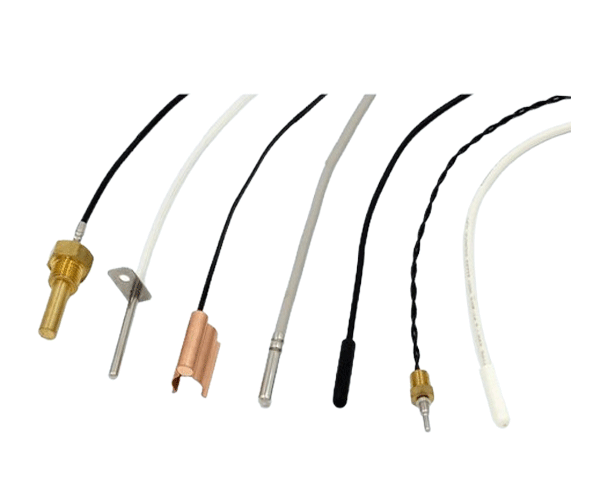
Temperature Sensors for Nuclear Reactors and Cooling Systems
In a Nuclear Plant, Temperature Is a Safety Parameter — Not Just a Process Number
Nowhere in industry does a temperature reading carry more weight than in a nuclear power plant. Reactor coolant temperature tells the operators where the core stands; feedwater and steam temperatures guard the secondary side; spent fuel pool and containment temperatures confirm that decay heat is being carried away. And the environment those sensors live in is among the harshest in any plant — high temperature and pressure, intense radiation, seismic loads, and design lives measured in decades. This article explains where temperature sensors are used across a nuclear plant, what makes an "extreme environment" sensor different from an ordinary industrial one, and why qualification and redundancy — not just accuracy — define the job.
≈ 290–330 °C
typical PWR primary coolant temperature
Pt100 RTD
the workhorse of coolant-loop sensing
4+
redundant safety channels per parameter
60 yr
design-life mindset for qualified parts
24/7
safety-grade monitoring
In one line — radiation-tolerant RTDs and thermocouples measure core exit, primary coolant loop, steam generator, spent fuel pool and containment temperatures, feeding redundant safety channels that drive reactor protection and cooling systems around the clock.
Why the Environment Is Extreme
Four Demands That Separate Nuclear Sensors From Industrial Ones
01
Radiation changes the sensor itself
Neutron and gamma radiation alters the resistance of platinum, shifts thermocouple calibration and degrades insulation materials over years of exposure. Sensors for reactor-side service are built from radiation-tolerant materials and designed so the drift is slow, predictable and correctable through calibration.
Mineral-insulated, radiation-tolerant element and sheath materials
02
High temperature and high pressure, permanently
Primary coolant runs near 300 °C at over 100 bar; steam lines and feedwater run hot as well. Sensors are fully sheathed, welded and seal-welded into thermowells — no elastomer gaskets, no field-removable plastic parts in the hot path.
Fully welded stainless construction inside qualified thermowells
03
The reading has to survive the accident it is meant to detect
Safety-related sensors must keep working under accident conditions — the loss-of-coolant accident environment of high temperature, humidity, radiation and vibration is part of the sensor's qualification envelope, not a hypothetical.
Environmental and seismic qualification covering normal and accident conditions
04
No single sensor is trusted alone
Safety parameters are measured through multiple independent, physically separated channels. The protection system votes among them, so one failed or drifted sensor cannot by itself hide a real condition — or trigger a false one.
Redundant channels with cross-comparison and channel-fault alarms
Important — scope of this article Sensors used in nuclear safety-related applications must conform to the plant's qualification requirements, the safety classification of each measurement, and the applicable nuclear standards and regulations of the plant's jurisdiction. Nothing in this article is a nuclear-qualification statement or a substitute for the plant's approved equipment list and engineering review — it is an engineering overview of where temperature sensing is used and what the environment demands of the sensor.
Application 1 — Reactor & Primary Loop
Reactor and Primary Coolant Temperature Monitoring
The key measurement points
|
Point
|
Typical sensor
|
Typical conditions
|
What it guards
|
|
Core exit temperature
|
Sheathed thermocouples (Type K / N class)
|
≈ 280–330 °C, high radiation
|
Distribution of coolant leaving the core; local anomaly detection
|
|
Primary loop hot / cold legs
|
Pt100 RTDs in qualified thermowells
|
≈ 290 °C hot leg / ≈ 290 °C cold leg (PWR reference)
|
Coolant temperature rise across the core — a core protection parameter
|
|
Pressurizer
|
Qualified RTDs / thermocouples
|
Saturated conditions, ≈ 345 °C
|
Pressure-temperature state of the primary circuit
|
|
Steam generator
|
RTDs / thermocouples on primary and secondary sides
|
Primary ≈ 290–330 °C; steam ≈ 270–290 °C
|
Heat transfer boundary between the primary and secondary circuits
|
|
Reactor protection inputs
|
Redundant safety channels per parameter
|
Safety-class instrumentation
|
Trips and operator actions defined by the reactor protection system
|
Reference values for a typical pressurized water reactor (PWR) at full power. Actual values, sensor types and safety classifications are defined by the specific reactor design and its licensing basis.
RTD
Why RTDs Rule the Coolant Loop
Pt100 RTDs offer excellent stability and linearity around primary-loop temperatures, and their drift under radiation is slow and characterizable — which is what a long service life demands.
TC
Thermocouples Where Speed Counts
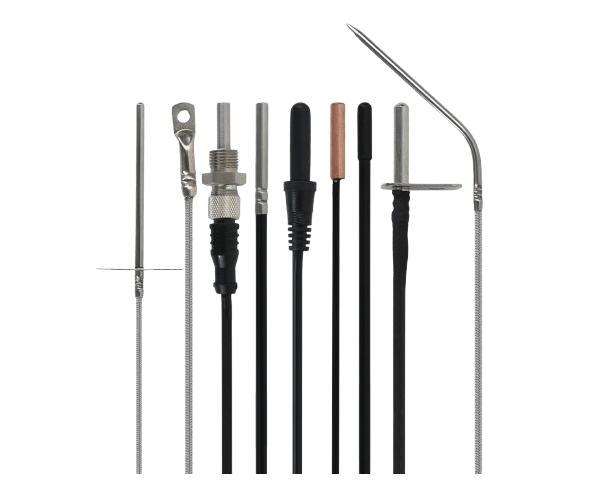
Fine, fully sheathed thermocouples respond faster than RTDs, which is why they serve at core exit, where detecting a local temperature excursion quickly matters most.
TW
Thermowells Keep the Boundary
The sensor lives inside a welded thermowell, so the pressure boundary is never opened to service or replace the element — the reactor stays sealed.
MI
Mineral-Insulated Cable
Magnesium-oxide insulated, metal-sheathed cable carries the signal out through containment penetrations, tolerating radiation, temperature and decades of service.
RED
Redundant Channels
Each safety parameter is measured by several independent, separated channels; the protection logic compares and votes, so one bad channel cannot drive a decision.
TEST
In-Situ Testing
Channel checks, calibration cross-checks and response-time testing (e.g. loop-current step tests and noise analysis) verify sensors without breaking containment boundaries.
Application 2 — Cooling & Plant Systems
Cooling Systems, Spent Fuel Pool and Containment Monitoring
Heat does not leave a nuclear plant at the steam generator. The secondary cycle, the ultimate heat sink, the spent fuel pool and the containment building all have temperature obligations — and each is a monitored safety or operations parameter.
|
System
|
Measured temperature
|
Why it matters
|
|
Secondary cycle (steam / feedwater)
|
Main steam, feedwater, condenser and heater temperatures
|
Efficiency and thermal balance of the power conversion side
|
|
Ultimate heat sink (sea / river / tower)
|
Intake and discharge water temperatures
|
Confirms the heat sink can absorb decay heat; environmental discharge limits
|
|
Spent fuel pool
|
Pool water temperature, several points
|
Decay heat removal from stored fuel — a permanently monitored safety parameter
|
|
Containment building
|
Multiple zone temperatures and humidity
|
Containment conditions under normal operation and accident analysis assumptions
|
|
Emergency & standby systems
|
Equipment rooms, diesel generators, battery rooms, HVAC
|
Keep the equipment that must run during events inside its qualified envelope
|
Spent Fuel Pool: Quiet but Continuous
Fuel continues to generate decay heat for years after removal from the core. Pool temperature is monitored continuously through redundant channels, with alarms that trigger operator action long before any limit is approached.
Containment: Sensors Behind the Wall
Containment sensors are sealed, radiation-hardened and inaccessible in service. They are installed for the plant's life, qualified for accident conditions, and verified through remote testing.
Heat Sink: Guarding the Last Link
Intake and discharge temperatures confirm the ultimate heat sink still works — in heat waves and drought years, this is the parameter that decides whether full power can be sustained.
Support Systems: The Unsexy Half of Safety
Battery rooms, diesel generator halls and ventilation systems have temperature limits that define whether the safety equipment itself is available. Monitoring them is part of plant readiness, not housekeeping.
The pattern across all of these: the further from the reactor core, the closer the sensors come to ordinary industrial designs — but the qualification mindset, documentation and redundancy discipline remain plant-wide, because every one of these temperatures can become a safety input in an abnormal event.
Selection & Discipline
What "Nuclear-Grade" Means for a Temperature Sensor
|
Sensor type
|
Typical nuclear service
|
Design features
|
Why
|
|
Pt100 RTD, fully sheathed
|
Coolant loop hot / cold legs, secondary cycle, pools
|
Mineral insulation, welded sheath, radiation-tolerant materials
|
Stability, linearity and characterizable drift at loop temperatures
|
|
Sheathed thermocouple (K / N class)
|
Core exit, fast-response points
|
Fine sheath diameter, fast response, welded hot junction
|
Speed of detection where a local excursion matters
|
|
Specialized extreme-environment designs
|
Containment and accident-qualified points
|
Hardened cable, sealed terminations, qualified envelope
|
Keep working under accident temperature, humidity, radiation and vibration
|
|
Industrial-grade RTDs / NTC (non-safety)
|
Equipment rooms, HVAC, support systems
|
Ordinary industrial construction, traceable calibration
|
Reliable service where conditions are mild but records still matter
|
Categories are indicative. Safety classification, qualification and procurement for nuclear service are governed by the plant's engineering process and applicable nuclear standards.
The discipline around the sensor
-
Qualification before selection — environmental, seismic and, where required, radiation qualification defined by the safety class of the measurement.
-
Traceability of everything — material certificates, calibration certificates and installation records follow each sensor through its life.
-
Redundancy by design — independent, physically separated channels for safety parameters; no single point of measurement failure can hide a condition.
-
Test without disassembly — in-situ verification methods keep sensors proven while the plant stays sealed and running.
-
Drift managed, not ignored — long-term drift is modeled, trended and corrected through scheduled calibration within the maintenance regime.
-
Substitution is an engineering event — replacing a safety-related sensor goes through design review, not the storeroom.
The signal chain
Qualified Sensorin welded thermowell
→
MI Cable & Penetrationout of containment
→
Redundant Channelssafety-grade acquisition
→
Protection & Operationtrips, alarms, operator actions
FAQ
Questions About Nuclear Temperature Monitoring
What temperature sensors are used in a nuclear reactor?
Two families. Fully sheathed thermocouples (K / N class) at core exit and other fast-response points, where detecting a local excursion quickly matters. Qualified Pt100 RTDs in welded thermowells on the primary coolant loop, pressurizer, steam generator and secondary systems, where stability and characterizable drift matter most. Safety-related applications use redundant, qualified channels.
Why do coolant loops use RTDs instead of thermocouples?
RTDs offer superior long-term stability and near-linear response around primary-loop temperatures, and their radiation-induced drift is slow and correctable through calibration. Thermocouples respond faster, which is why they take the core-exit role. The two are complementary rather than competing.
Does radiation really change a temperature sensor?
Yes. Neutron and gamma exposure alters platinum resistance characteristics, thermocouple calibration and insulation materials over time. This is precisely why reactor-service sensors use radiation-tolerant materials and why drift is modeled, trended and corrected through scheduled calibration instead of being assumed away.
What does "qualification" mean for a nuclear sensor?
That the sensor — and its cable and terminations — has been verified to perform its function across its entire envelope: normal operating conditions, accident conditions where applicable, seismic loads, and the plant's service life. Qualification is defined by the measurement's safety classification and the applicable nuclear standards; it is documented, traceable and reviewed — never assumed from a datasheet.
Why are there redundant sensors for one temperature?
Safety parameters are measured through multiple independent, physically separated channels. The reactor protection system compares and votes among them, so a single failed or drifted sensor can neither hide a real condition nor trigger a false trip. Redundancy is a design requirement, not an option.
How are sensors inside containment tested if nobody can enter?
Through in-situ methods: channel checks against redundant sensors, loop-current step tests and noise-analysis response-time testing, all performed from outside containment. The sensor is verified electrically and functionally without opening the pressure boundary or entering the building.
Is an ordinary industrial RTD ever used in a nuclear plant?
Yes — outside the safety-classified systems. Equipment rooms, HVAC, workshops and other non-safety support systems use ordinary industrial-grade sensors with traceable calibration. The distinction is the safety classification of the measurement, which is decided by the plant's engineering and licensing process, not by the sensor vendor.
Engineering temperature sensing for demanding environments?
Tell us the measurement point, environment and required documentation. We will discuss what our RTD and thermocouple designs can do for non-safety and demanding industrial applications — with honest guidance on qualification boundaries.
Get a Quote & Consultation