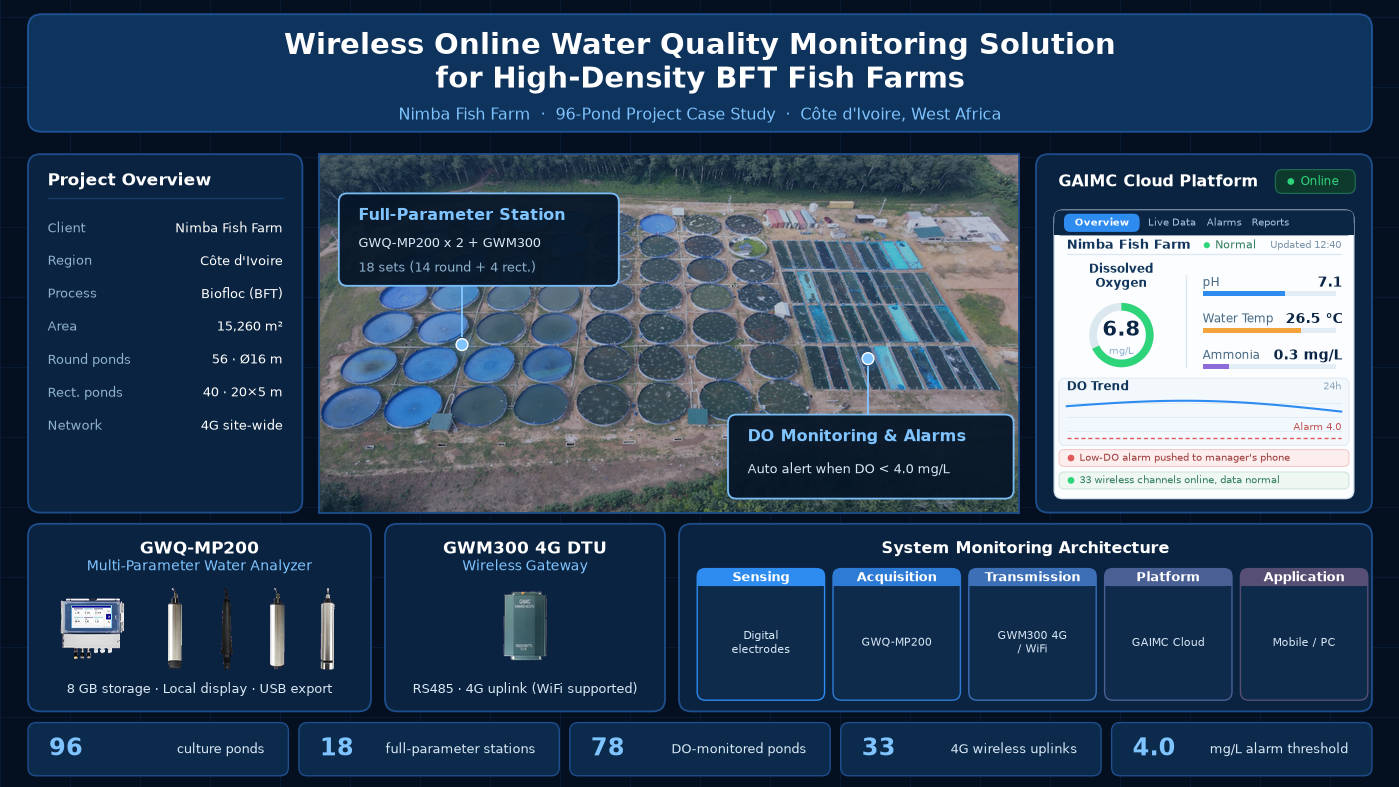
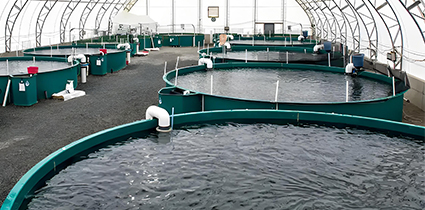
Nimba Fish Farm, located in Côte d'Ivoire, West Africa, runs high-density fish farming with the biofloc process (BFT). Production is organized by culture series across 96 ponds — 56 circular ponds (Ø16 m × 1.2 m) and 40 rectangular ponds (20 m × 5 m × 0.8 m) — with feeding and water-quality management carried out uniformly per series. To safeguard fish grown at such high densities, the farm needed a site-wide continuous water-quality monitoring system to replace manual inspection and experience-based judgment.
Why BFT water is hard to monitor
In a BFT system, fish are raised at high density in closed ponds. Carbon sources are dosed to regulate the carbon-nitrogen ratio, cultivating a biofloc dominated by heterotrophic bacteria that converts ammonia nitrogen and nitrite in-situ and reuses protein — saving water, delivering high yield, and keeping emissions low.
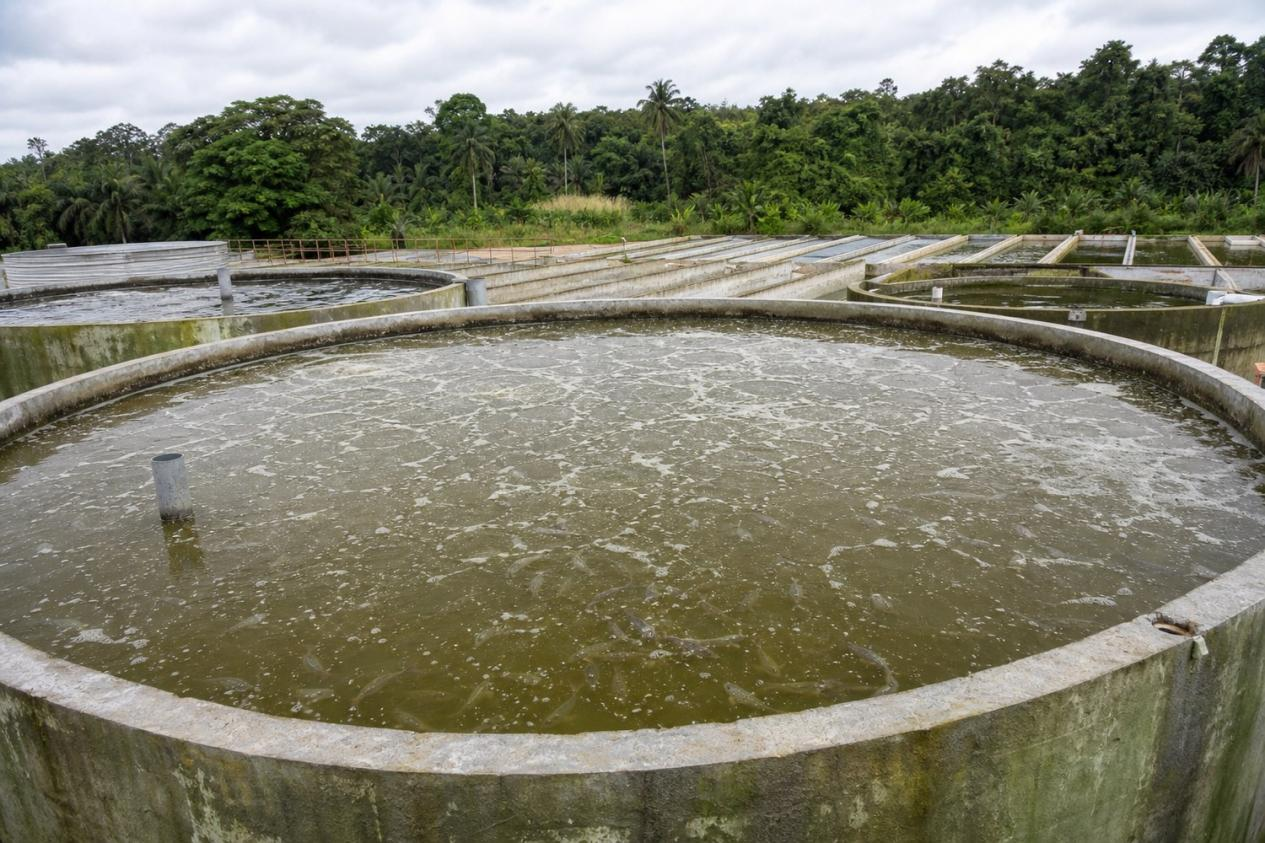
But the same biology defines the monitoring challenge: the water carries a high concentration of suspended solids, close to an activated-sludge environment. Biofilms attach quickly to probe surfaces and drift readings of key parameters such as dissolved oxygen. Meanwhile, biofloc metabolism consumes large amounts of oxygen, making dissolved oxygen the single most critical parameter that requires continuous, reliable monitoring across the whole site.
Figure 1 · Water in BFT biofloc culture ponds
Site conditions at a glance
Condition item
On-site situation
Culture water area
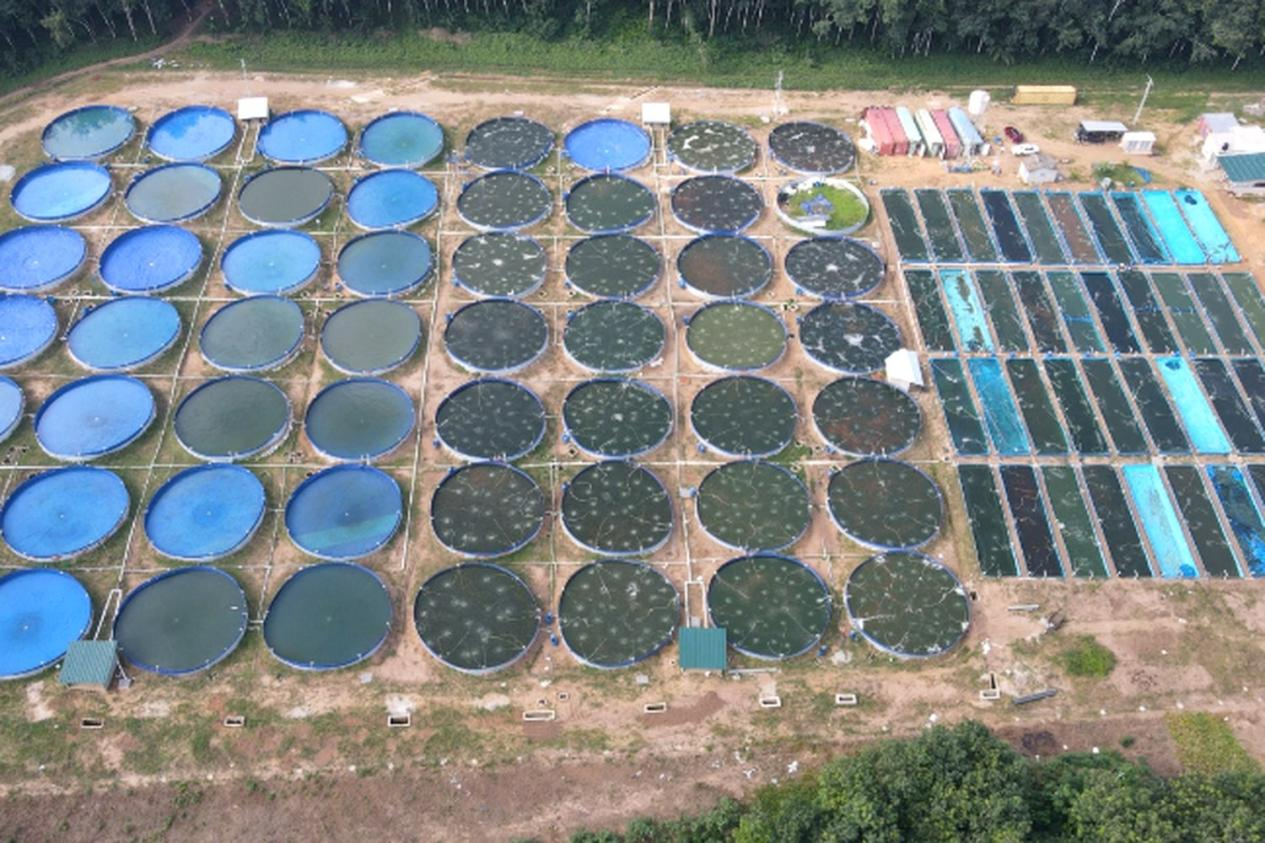
About 15,260 m² (56 circular ponds ≈ 11,260 m² + 40 rectangular ponds 4,000 m²)
Pond layout
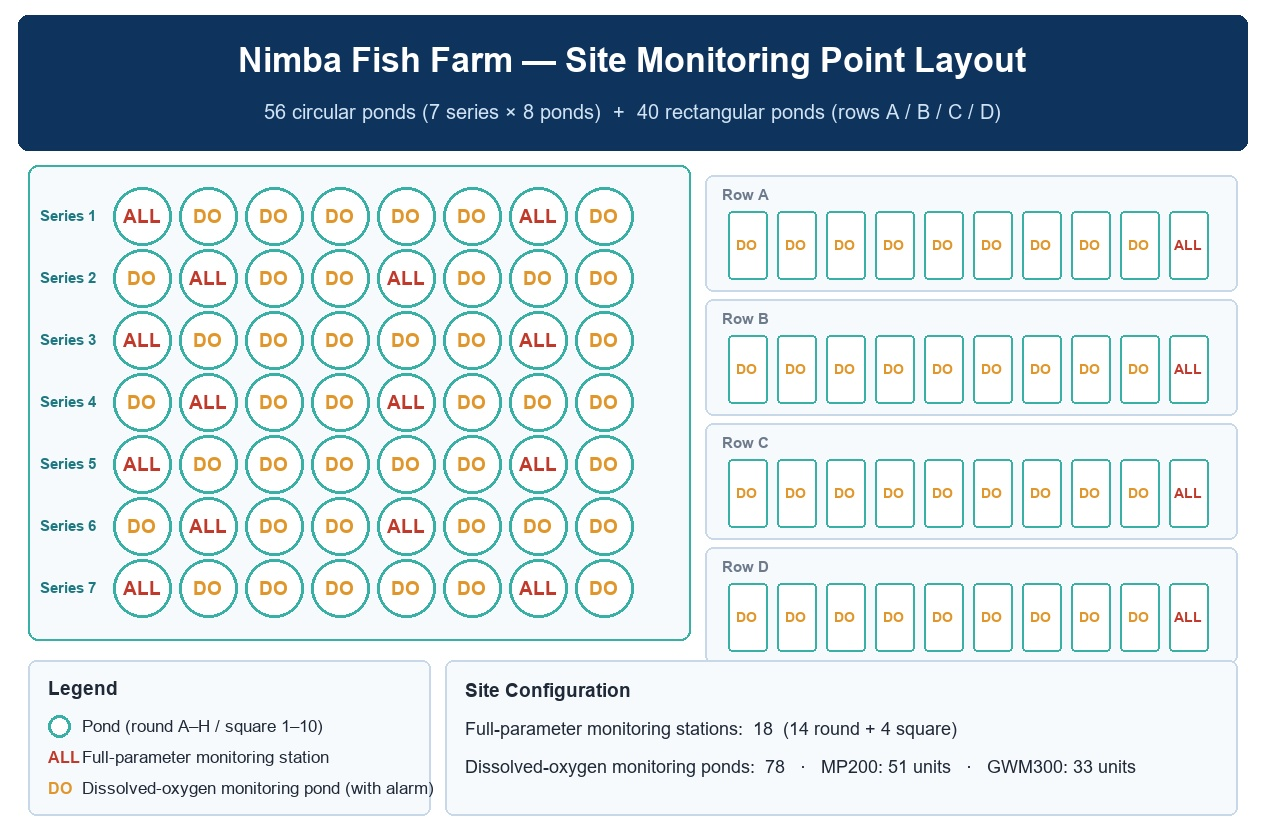
96 ponds total; circular ponds organized into 7 culture series of 8 ponds each (A–H); rectangular ponds in 4 rows (A / B / C / D) of 10 ponds each
Pond specs
Circular: Ø16 m × 1.2 m deep · Rectangular: 20 m × 5 m × 0.8 m deep
Site span
Circular ponds: 146.2 m × 117.5 m · Rectangular ponds: 84 m × 63.5 m
Power & communication
220 V / 50 Hz covers the site; stable 4G signal, WiFi coverage also available
Monitoring tiers
14 circular + 4 rectangular ponds (18 sites) with full-parameter stations; the other 78 ponds monitor dissolved oxygen
Alarm requirement
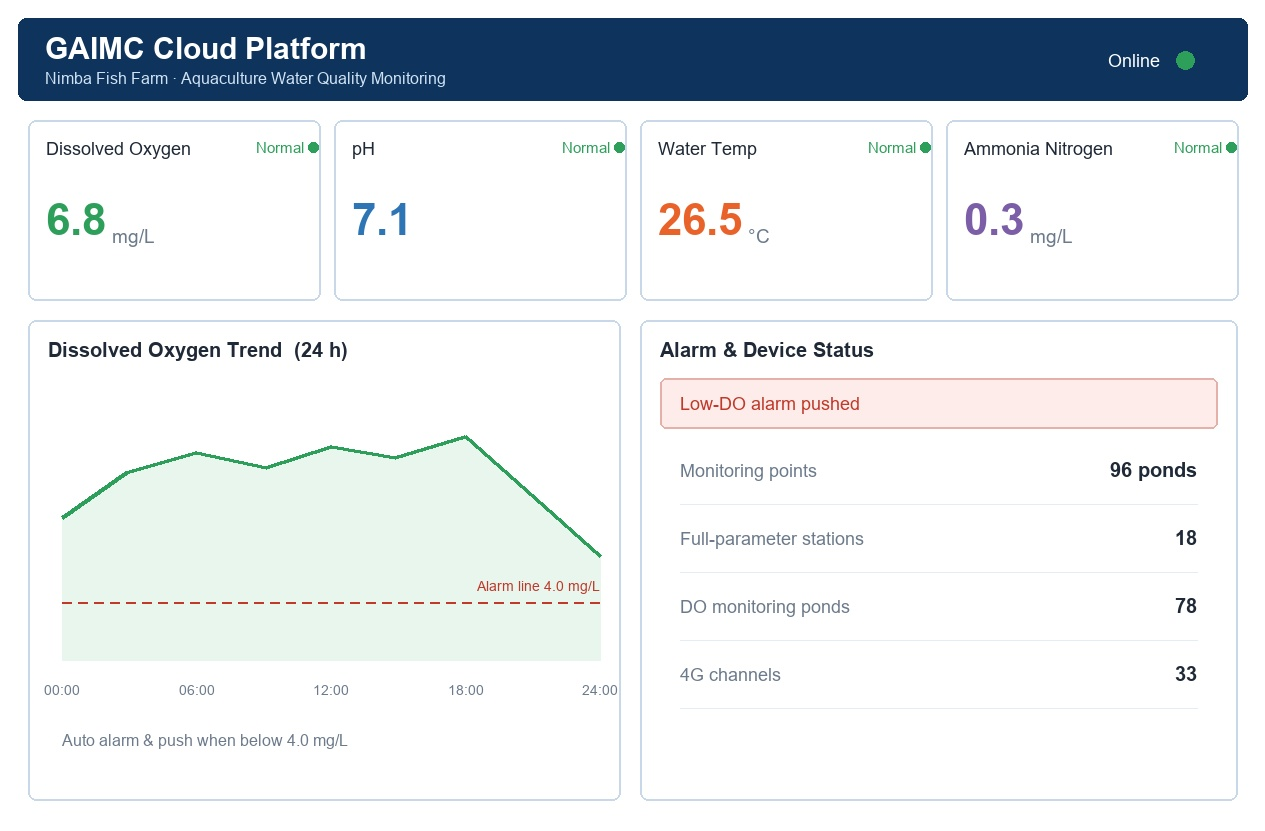
Auto alarm and push to management when DO falls below 4.0 mg/L
Figure 2 · Aerial view of Nimba Fish FarmFigure 3 · Site-wide monitoring point layout
Section 02
Customer Requirements and Pain Points
Core requirements
Sensor-based continuous water-quality monitoring for all 56 circular and 40 rectangular ponds.
Tiered configuration: 18 full-parameter stations covering pH, ORP, dissolved oxygen, suspended solids, sludge concentration, water hardness, COD, BOD, ammonia nitrogen and water temperature; the other 78 ponds monitor DO with alarms.
Wireless data transmission to avoid per-pond wired cabling across the site.
Probes adapted to high-suspended-solids BFT water, immune to biofilm-attachment drift.
Automatic alarm below 4.0 mg/L DO, pushed directly to management via SMS / WhatsApp, located by specific pond.
Centralized monitoring grouped by culture series, aligned with each series' stocking and harvesting rhythm.
On-site data viewing, retention and export; sensor brackets supplied, cable lengths optimized for installation.
On-site pain points
Biofilm drift
High suspended solids let biofilms attach fast to probe surfaces; DO readings drift and distort.
146 m cabling span
A single culture series spans up to 146.2 m. Centralizing instruments on one side would make sensor cabling extremely complex.
Slow low-oxygen response
96 ponds can't be covered by manual patrol; low oxygen must be warned precisely by pond and reach management directly.
Many parameters, scattered points
10 parameters monitored continuously across 7 culture series and 4 rectangular-pond rows — multi-point, multi-parameter parallel acquisition.
Local readability & traceability
The site needs to view data at any time for patrol, feeding and response, plus retention and export for retrospective analysis.
Freight & phased investment
Longer cables raise shipping weight and freight cost; the customer planned to pilot 3–4 ponds first, then scale site-wide.
Section 03
Overall Solution
Figure 4 · Overview of the BFT high-density farm water quality monitoring and networking solution
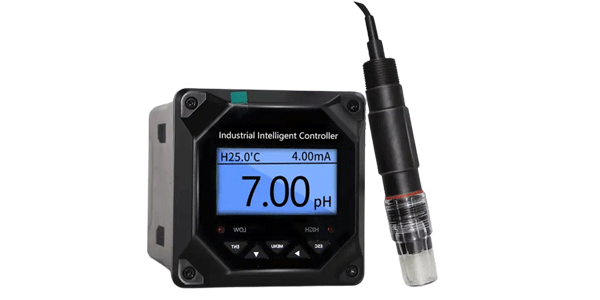
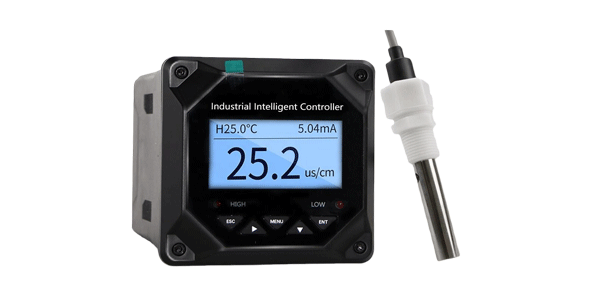
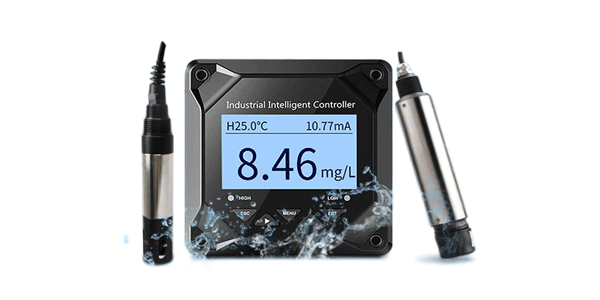
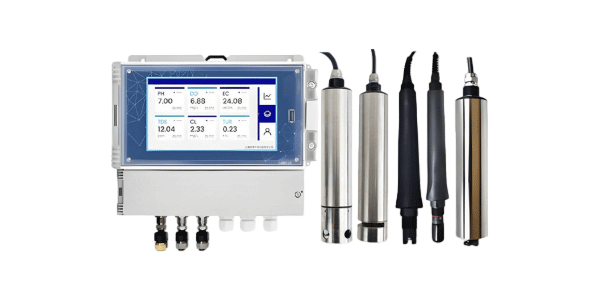
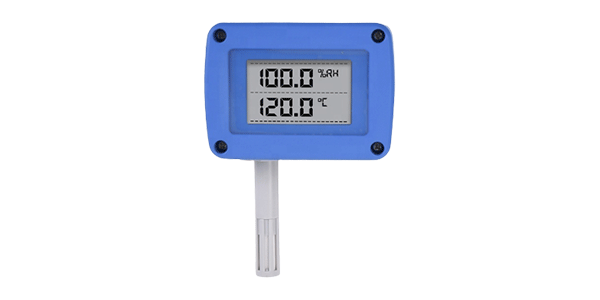
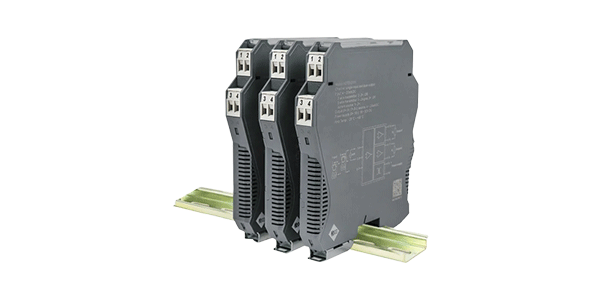
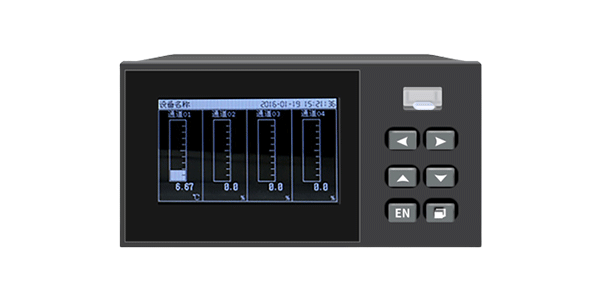
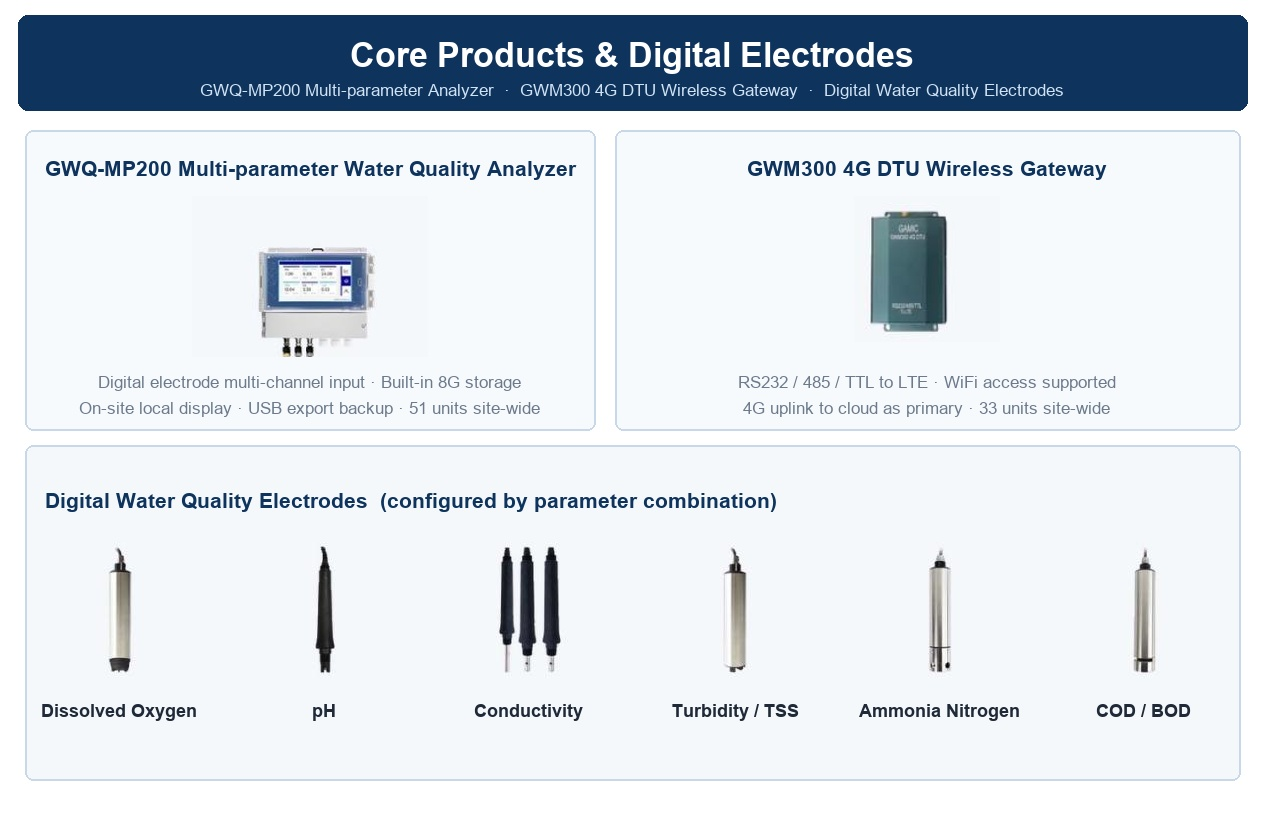
Multiparameter water quality analyzer — 2nd-gen color screen, multi-channel digital-electrode interface, 8 GB built-in storage
51 units
Each full-parameter station needs 8 electrodes (10 parameters consolidated), exceeding a single host's channels — so 2 units per station, also meeting on-site display needs. The 78 DO ponds are configured 1 unit per monitoring group. 8 GB storage with USB export covers on-site data retention.
GWM300
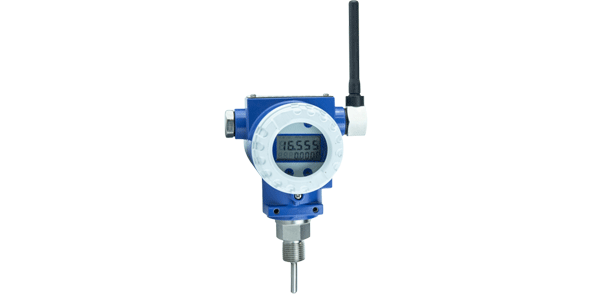
4G DTU wireless gateway — RS232 / 485 / TTL to LTE, 4G and WiFi cloud access
33 units
Site-wide wireless cloud uplink: 18 full-parameter stations share 1 channel per station for 2 instruments; DO groups use 1 channel per group — 33 channels total. 4G primary (independent of the on-site network), WiFi as a low-cost option and backup.
Digital electrodes
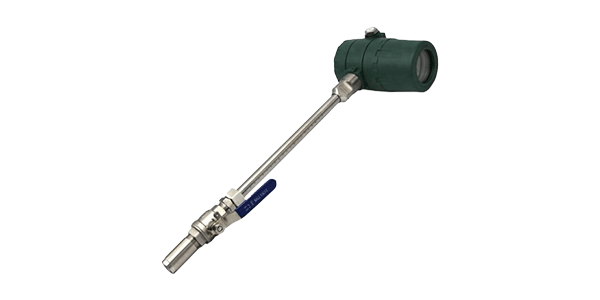
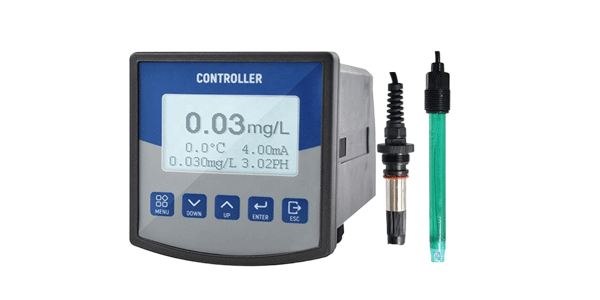
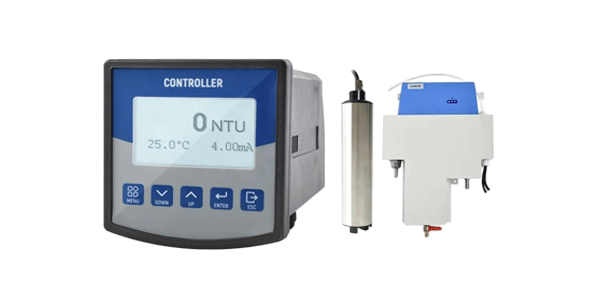
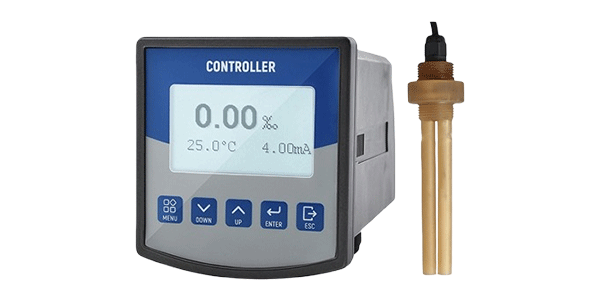
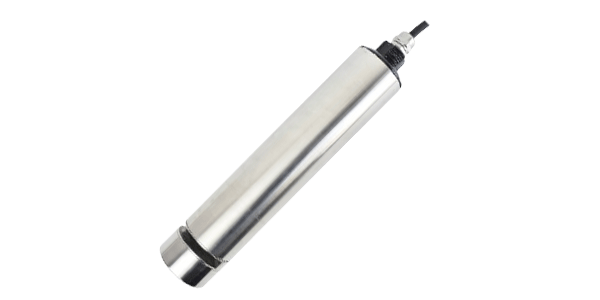
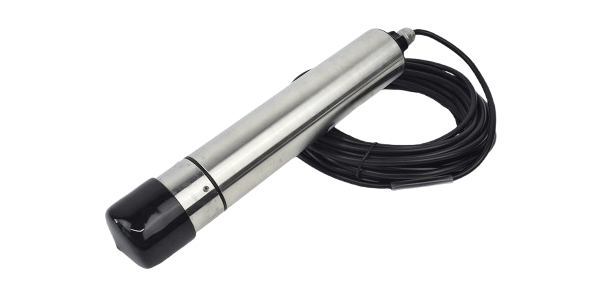
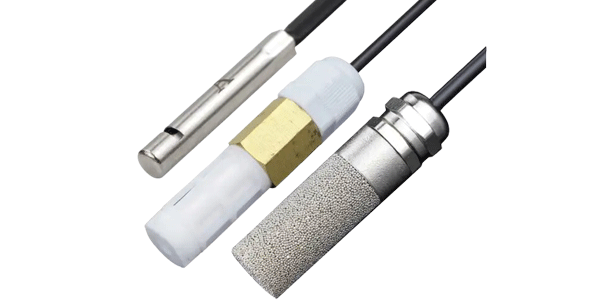
Front-end parameter acquisition, incl. digital fluorescent DO electrode; turbidity / suspended-solids / COD-BOD electrodes with automatic cleaning
By parameter combination
DO uses an interference-resistant, reagent-free fluorescent optical electrode; electrodes prone to biofilm attachment carry automatic cleaning to hold long-term measurement stability.
Mounting bracket
Vertical-pipe electrode bracket, clamp-fixed to pond edge
Site-wide
Threaded connection for easy install/removal; immersion depth adjusted by pond type and water depth.
Parameter consolidation: COD and BOD share one electrode, and water temperature is obtained through the temperature-compensation function of other electrodes — so a full-parameter station's 10 monitoring parameters require only 8 electrodes, cutting electrode count and installation points.
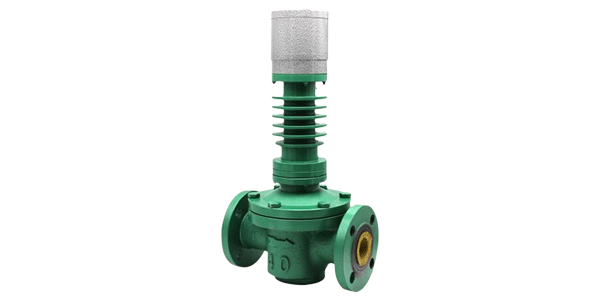
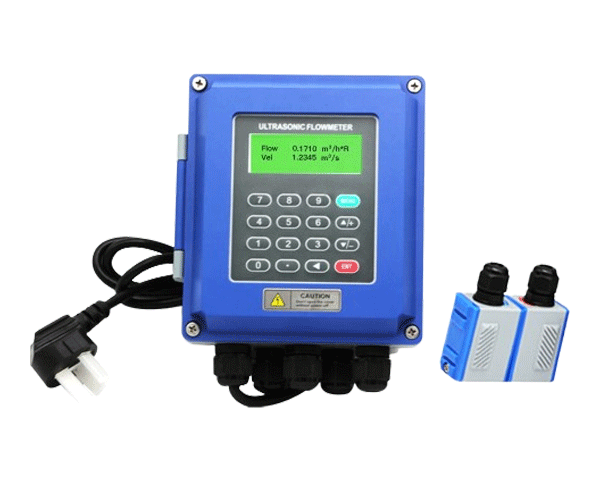
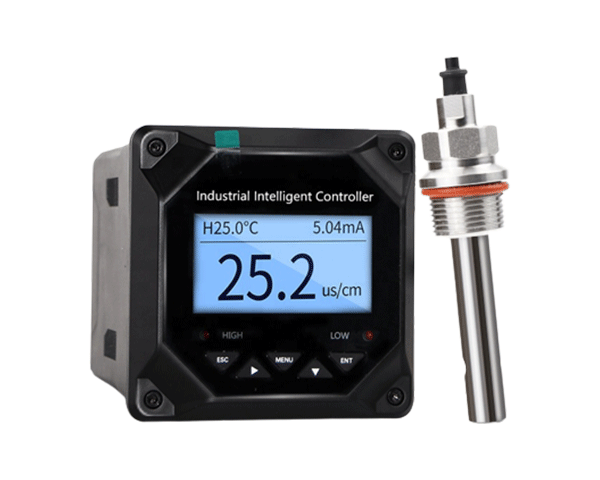
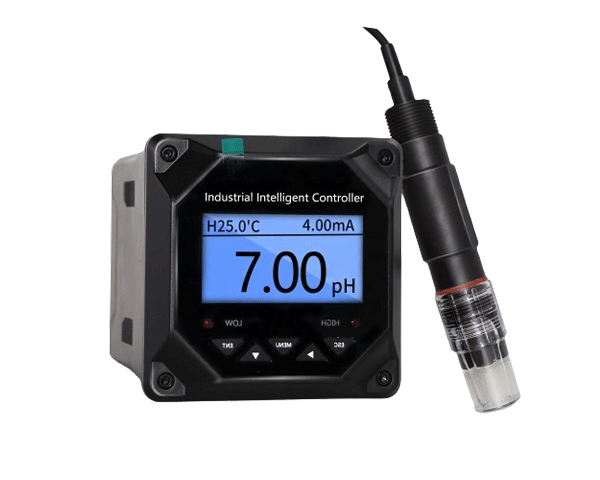
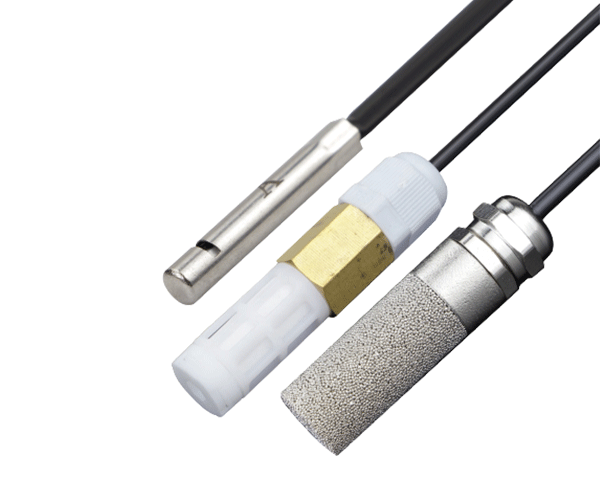
Figure 5 · Core products and digital electrodes
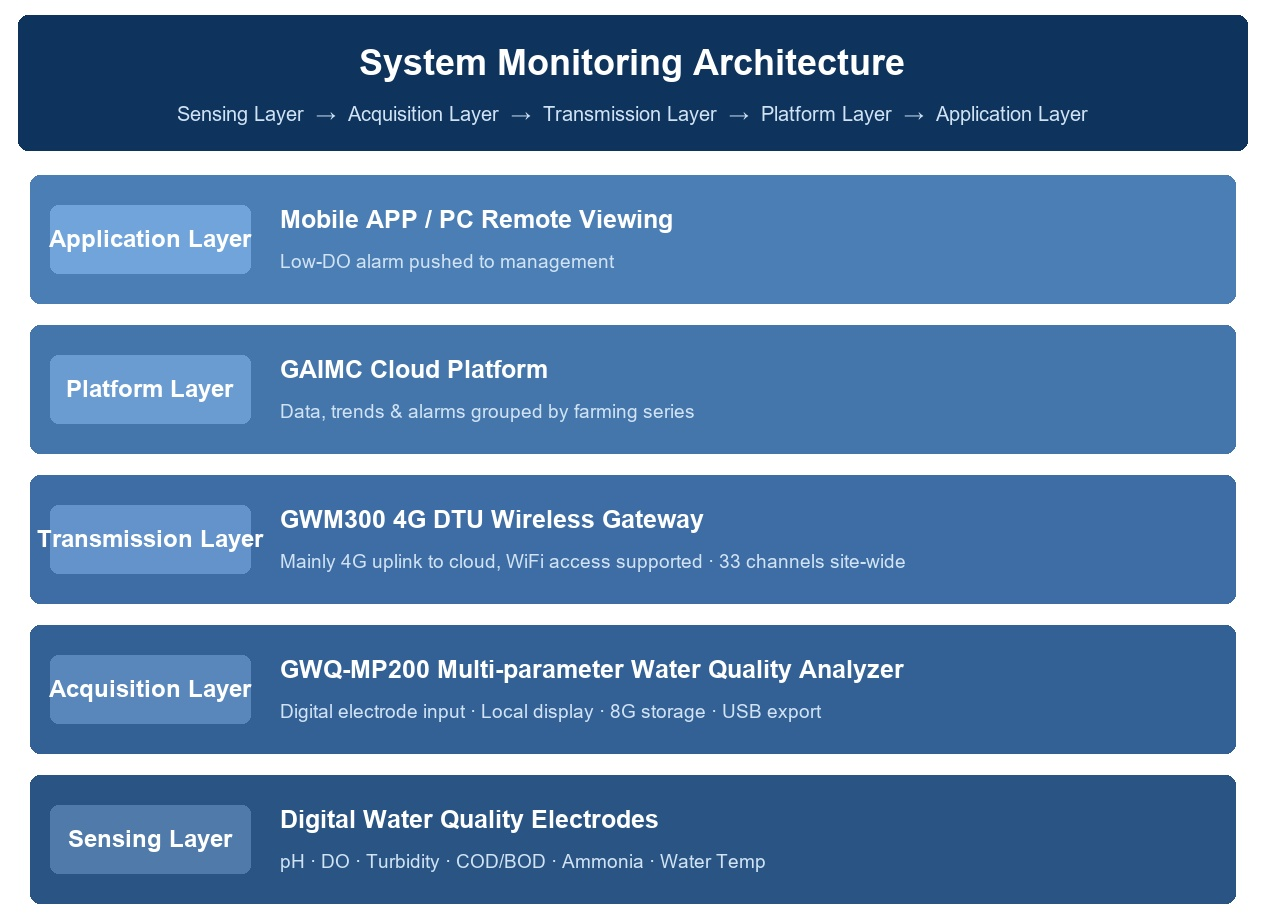
System monitoring architecture
Layer
Component
Description
Perception
Digital water-quality electrodes
Deployed in each pond; full-parameter stations carry 8 consolidated digital electrodes (auto-cleaning on turbidity / TSS / COD-BOD); DO ponds carry digital fluorescent DO electrodes
Acquisition
GWQ-MP200 analyzer
Installed near the pond area; accesses electrodes via RS485, performs acquisition, local display and alarm-threshold judgment; 8 GB storage + USB export
Transmission
GWM300 4G DTU gateway
Connects to the analyzer via RS232 / 485 / TTL and uploads to the cloud; 4G primary, WiFi supported; 33 channels site-wide
Platform
GAIMC cloud platform
Real-time data and historical trends grouped by culture series; DO alarm rules configured at 4.0 mg/L
Sensors connect to the analyzers via RS485 digital signals — under standard conditions the bus supports runs up to about 1,000 m, and cable lengths flex to the pond-group layout, absorbing the 146.2 m span of a single culture series. From analyzers to the cloud, data travels over 4G (or existing WiFi).
Figure 6 · System monitoring architecture
Installation and deployment
Locations
Circular-pond instruments are installed at the center of each area (may be split in two); rectangular-pond instruments at the row center. The GWM300 sits near its analyzer and shares one 4G uplink, cutting cross-area cabling.
Distributed vs. centralized
Two configurations were weighed: distributed near-installation (closer to each pond group, longer sensor cables) vs. centralized along one side (shorter cables, easier management, lower freight weight).
Wiring & power
RS485 digital cables sized to the pond layout; 220 V / 50 Hz already covers the site, so no extra power-distribution work. The GWM300 only avoids strong EMI and metal-shielded spots; in WiFi-covered zones it can switch to WiFi to cut channel cost.
Pilot-first rollout
3–4 ponds were piloted first; after data stability and the alarm link were confirmed, deployment rolled out site-wide — the pilot shares the exact architecture of the full solution, so nothing was duplicated.
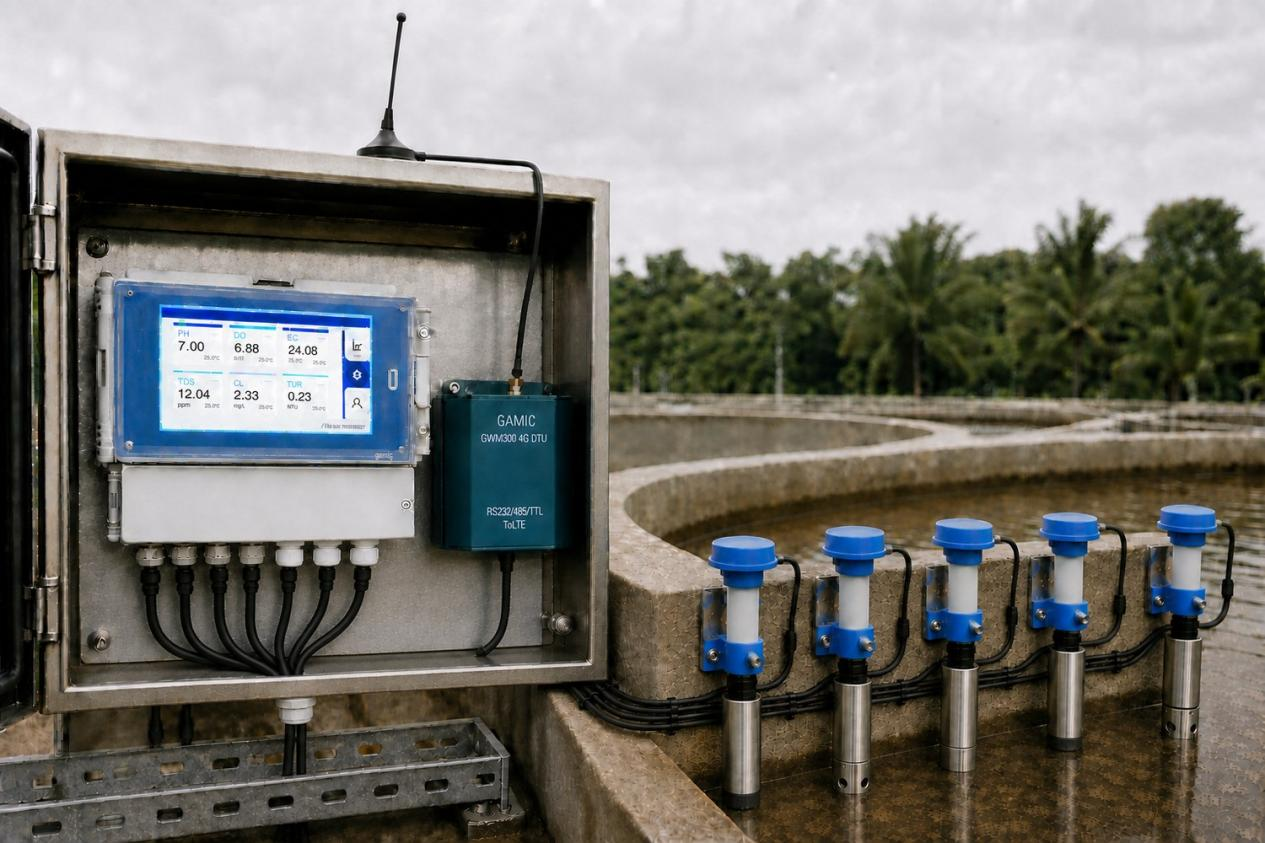
Key installation points: auto-cleaning electrodes are positioned so the cleaning mechanism is never obstructed by the pond wall or bracket; electrodes hang vertically with immersion depth set by water depth (1.2 m circular / 0.8 m rectangular) to avoid touching bottom or breaking the surface; the 4G antenna mounts by suction cup on top of the control cabinet — feeder through the cable gland — to avoid metal-shielding loss inside the cabinet.
Figure 7 · On-site installation — control cabinet, suction-cup antenna and vertical-pipe electrode bracket
Section 04
Application Results and Customer Value
Core solution advantages
1
Electrodes built for high-suspended-solids BFT water. Reagent-free digital fluorescent DO electrode resists interference; turbidity, suspended-solids and COD/BOD electrodes carry automatic cleaning — less manual scrubbing, stable long-term readings.
2
8 GB on-board storage with local display and USB export. Real-time and historical data are viewable on the 2nd-gen color screen; USB backup safeguards against network fluctuations and supports later tracing.
3
4G-primary, WiFi-secondary dual-channel cloud design. Independent, stable cloud access with flexible deployment; WiFi in covered zones further lowers IoT channel cost.
4
Wireless replaces per-pond wiring. 33 wireless channels complete cloud upload and absorb the 146.2 m span — instruments collect and upload locally in each pond area, no long-distance runs to a centralized point.
5
Automatic 4.0 mg/L DO alarm, straight to management. Pushed via SMS / WhatsApp / email, with the alarm source located by specific culture pond.
6
Parameter consolidation + dual-analyzer stations. 10 parameters on 8 electrodes; 2 GWQ-MP200 units per station cover both full-parameter measurement and on-site display.
7
Data grouped by culture series. Cloud display follows the 7 circular-pond series and 4 rectangular-pond rows, matching stocking and harvesting rhythm for per-batch traceability.
8
Pilot and expansion on the same architecture. After validating the pilot ponds, the solution expanded to all 96 ponds with no platform change and no duplicate investment.
Quantified benefits
Metric
Solution data
Culture water coverage
About 15,260 m² — 96 ponds (56 circular + 40 rectangular), 100% covered
Auto-cleaning electrodes cut probe-cleaning frequency and manual maintenance under high-suspended-solids conditions.
Local display + 8 GB storage mean data is viewable and retained on site with no extra equipment; USB export simplifies periodic archiving.
Centralized cloud viewing from phone or PC reduces site patrols and manual recording.
Series-grouped data aligns with stocking and harvesting rhythm for per-batch traceability.
Alarm push closes the loop from data to resolution — management handles low-oxygen ponds at the first moment.
Cable sizes, bracket accessories and the pilot-to-expansion path are clearly defined for phased, budget-friendly implementation.
Section 05
Project Summary
The Nimba Fish Farm project targets a high-density BFT scenario with 96 ponds, about 15,260 m² of culture water and a 146.2 m single-series span — simultaneously testing the reliability, coverage and engineering feasibility of any water-quality monitoring system.
The solution answered at three levels. Measurement reliability: electrodes configured by parameter characteristics — auto-cleaning on biofilm-prone probes, digital fluorescent DO — keep data stable long-term. Engineering implementation: 33 4G wireless channels replaced per-pond cabling, turning a long-span cabling problem into simple local collection and grouped cloud upload. Management closed loop: the cloud platform displays data by culture series, alarms automatically at the 4.0 mg/L DO threshold and pushes directly to management, while 8 GB on-board storage supports on-site viewing and retention.
The architecture is highly replicable — tiered monitoring + digital electrodes + multiparameter host + 4G wireless gateway + cloud-platform alarm — and applies directly to other high-density culture, biofloc and standardized pond-culture projects.
FAQ
Frequently Asked Questions
Why is dissolved oxygen the most critical parameter in a BFT farm?
Biofloc metabolism consumes large amounts of oxygen, and stocking density is high, so a drop in DO can hit the whole pond within hours. Nimba Fish Farm set the alarm threshold at 4.0 mg/L — the system alarms automatically and pushes the alert to management, located by individual pond.
How do the electrodes cope with biofilm in high-suspended-solids water?
Dissolved oxygen uses a reagent-free digital fluorescent (optical) electrode that resists interference. Electrodes prone to biofilm attachment — turbidity, suspended solids and COD/BOD — are equipped with automatic cleaning, which reduces manual cleaning frequency and keeps long-term readings stable.
Does a 146 m-wide site need long wired runs?
No. Sensors connect to the analyzer over an RS485 digital bus that supports runs up to about 1,000 m, and the analyzer uploads to the cloud over 4G. Across the whole farm, 33 GWM300 wireless channels replace per-pond cabling: each pond group collects and uploads locally.
How many analyzers does one full-parameter station need?
Two GWQ-MP200 units. A station monitors 10 parameters, consolidated to 8 electrodes (COD/BOD share one electrode and water temperature comes from temperature compensation), which exceeds a single host's channels — the second unit also serves on-site display.
Can the farm start with a pilot and expand later?
Yes. The recommended path is to install 3–4 culture ponds first; the GWQ-MP200 and GWM300 used in the pilot share the exact architecture as the site-wide solution, so after validation it expands to all 96 ponds with no platform change and no duplicate investment.
How is a low-oxygen alert delivered to management?
When DO drops below 4.0 mg/L the platform alarms automatically and pushes the notification to management via SMS, WhatsApp and email, with the alarm source identified by specific culture pond so the right pond is treated immediately.