AI Data Center Environment & Thermal Management Monitoring Solution
TIME: 2026.10.16NUMBER OF VIEWS 1819
Data Center & AI Computing Infrastructure
AI Data Center Environment & Thermal Management Monitoring Solution
Cold aisle / hot aisle · CRAC supply & return air · rack-level sensing · outdoor weather · wireless retrofit — a five-level precision environment network for air-cooled and hybrid-cooled AI computing rooms.
18–27℃
Cold aisle inlet ASHRAE band
40–60%
Target RH, condensation & ESD control
5 Levels
Aisle · duct · rack · outdoor · wireless
6+ Forms
Wall / duct / micro / outdoor / wireless
4–20mA·RS485
+ 4G cloud, DCIM/BMS ready
Who this is for: data center and AI computing room operators running air-cooled or air-liquid hybrid facilities — especially those facing localized hotspots, manual inspection bottlenecks, humidity/condensation risk, or PUE audit requirements without continuous environment data.
Industry Overview: Air-Cooled Rooms Enter the "Precision Environment" Era
AI inference and general computing growth have pushed machine rooms into a precision-environment era. Cold aisle inlet temperature must stay within the 18–27℃ ASHRAE-recommended band with 40–60% relative humidity, while rising rack power density makes localized hotspots frequent and hard to predict. Even as liquid cooling accelerates — penetration projected around 37% by 2026 — air cooling and air-liquid hybrid designs remain the backbone of over 60% of installed data center capacity.
GAIMC builds a five-level environment monitoring network — cold aisle, hot aisle, supply/return air, rack level, and outdoor — using its temperature & humidity product family:
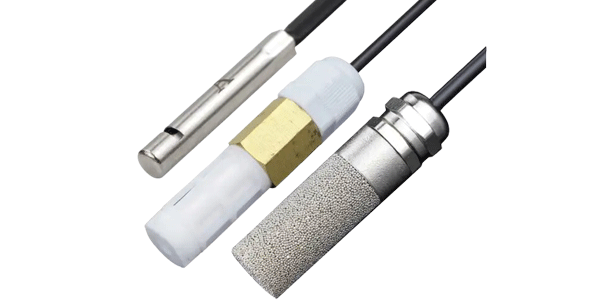
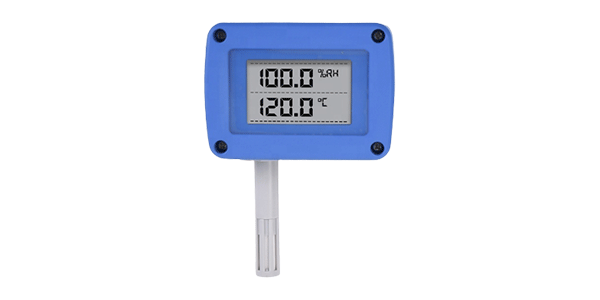
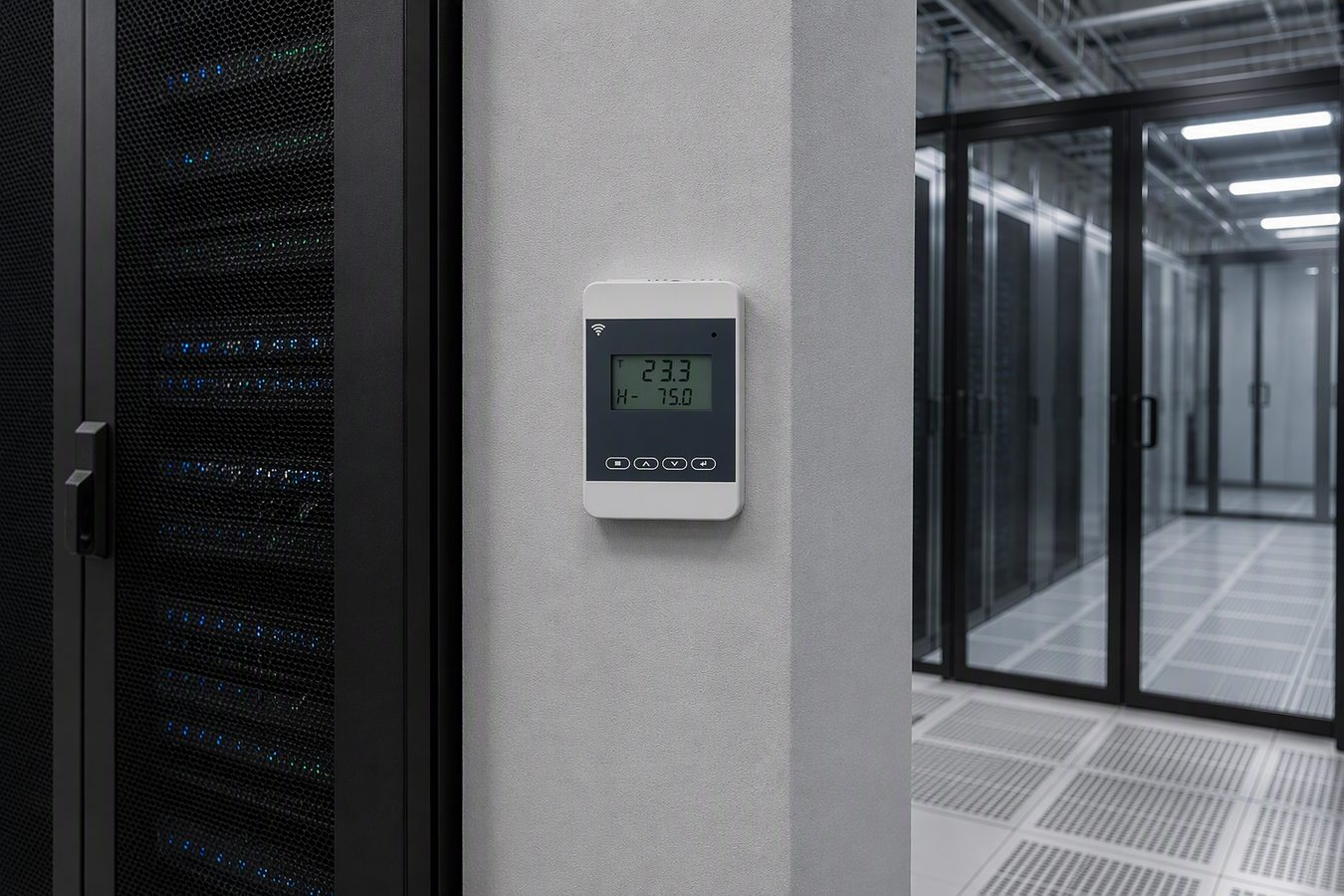
GTHT350 wall-mounted transmitters on cold/hot aisle posts for supply-side and return-side temperature & humidity
GTHT310 / GTHT100 duct-type transmitters for CRAC supply and return air
GTHT391 micro sensors for rack-level inlet monitoring
GTHT318 outdoor weather station units for fresh-air and heat-rejection decisions
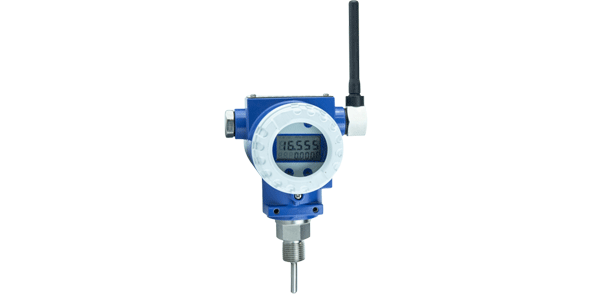
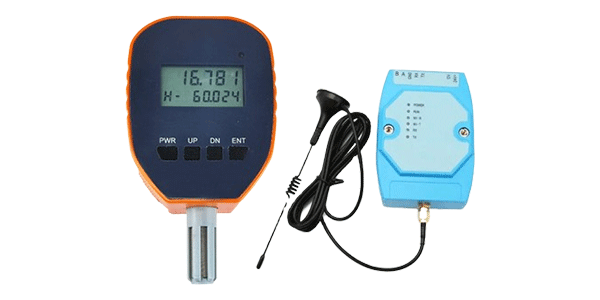
GTHT270 / GTHT290 wireless sensors for retrofits and cross-floor points — no cabling required
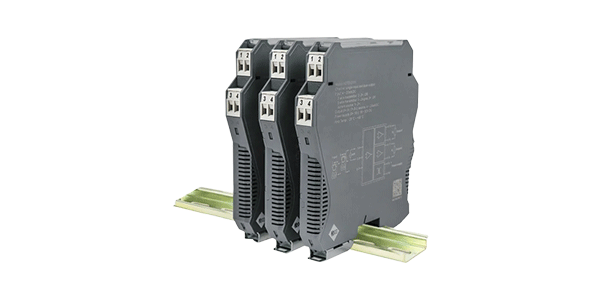
All data reaches the FM/DCIM/BMS layer via 4–20mA or RS485 (with GSI600 signal isolation where needed) and uploads to the cloud via GWM300 4G DTU. Linked with precision air conditioning (CRAC), the system pinpoints hotspots, prevents condensation and static discharge, and makes PUE environment-side accounting possible — moving machine-room environments from the "inspection era" into the "visibility era".
Figure 1. Wall-mounted temperature & humidity transmitters deployed along rack rows in an air-cooled precision data center
Pain Points: Why Single-Point Sensing No Longer Works
Hotspots are rack-scale, not room-scale
As rack density rises, hotspots appear as isolated points. Room-level temperature readings cannot locate which rack is overheating — until chips throttle or trip.
Airflow short-circuit in contained aisles
Closed cold/hot aisles develop "partly overcooled, partly overheated" zones. Overheated racks suffer frequency throttling and unplanned downtime.
Manual inspection can't keep up
Environment changes outpace patrol frequency. Multi-room, cross-floor sites depend on physical presence; night shifts are thinly covered.
No visibility on supply/return air
Without duct-level points, CRAC supply temperature drift and humidity control failure give no early signal until alarms cascade.
Condensation & static risk without warning
Humidity excursions toward condensation or ESD-prone dryness are invisible between inspections — a silent threat to boards and connectors.
PUE audit lacks continuous data
PUE assessment and environmental audits need traceable, continuous records — single-point manual readings don't stand up to review.
The cost of losing control of the machine-room environment is chip throttling, downtime, and wasted energy. Traditional single-point thermometers and manual spot checks no longer meet precision-environment management requirements.
Overall Monitoring Solution
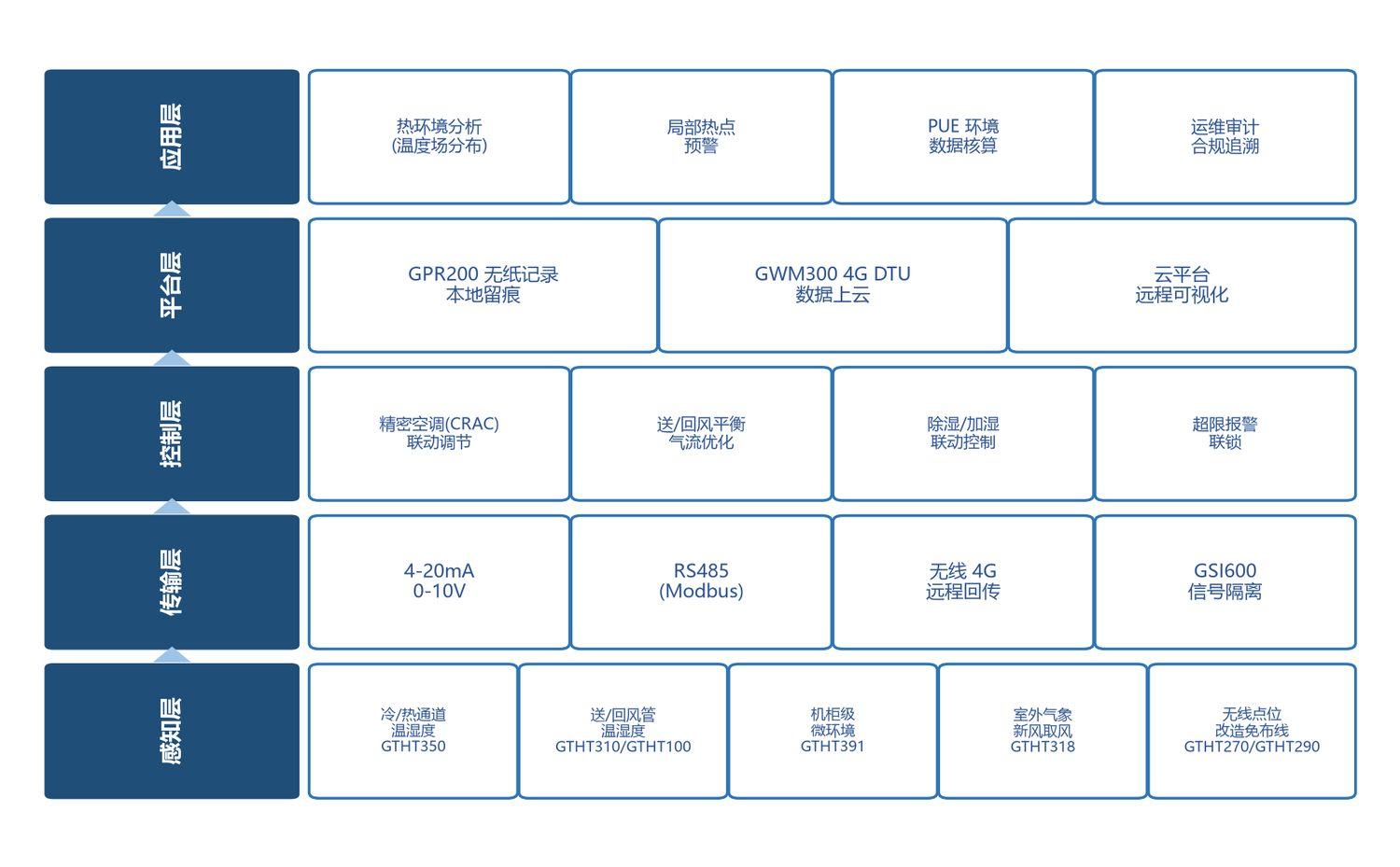
3.1 System Architecture: Five Layers, Six Deployment Steps
The solution follows GAIMC's closed loop of real-time monitoring → linked regulation → automatic alarm → remote visualization → data traceability, deployed in five layers:
Deployment follows a six-step closed loop: point planning (four sensing categories) → model selection → installation → system integration → platform go-live → closed-loop operation. Existing rooms can start with the highest-risk points (cold aisles and CRAC ducts) and expand to rack-level and wireless coverage without shutdown.
Typical Application Scenarios
Scenario 1 · Hot/Cold Aisle Precision Environment
GTHT350 (aisle posts) + GTHT391 (rack level) form a multi-point sensing grid that precisely locates hotspots and links with CRAC units for targeted airflow — preventing condensation on one end and overheating shutdown on the other.
Figure 3. Wall-mounted transmitters on hot/cold aisle containment for supply-side and return-side sensing
Scenario 2 · CRAC Supply/Return Air Monitoring
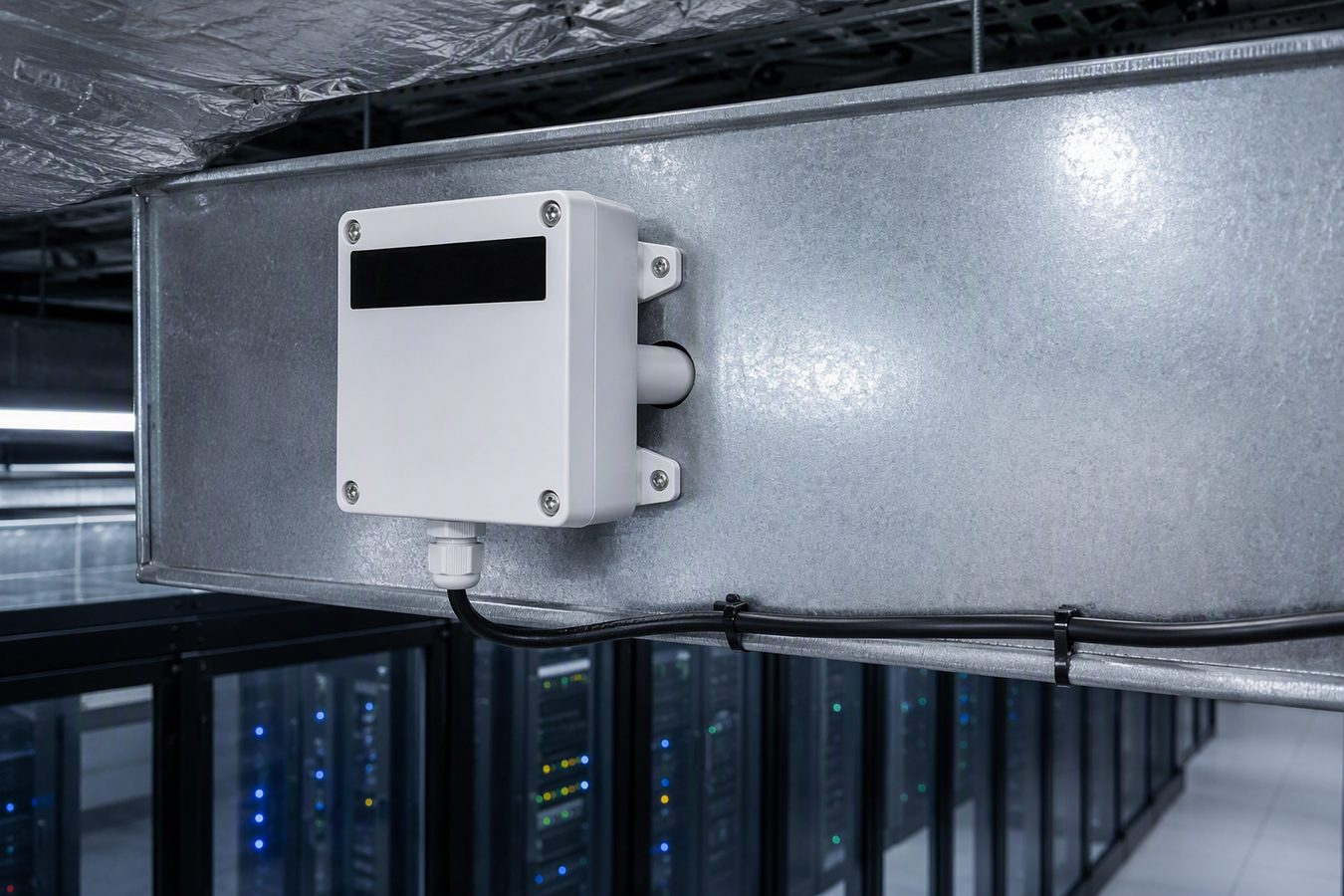
GTHT100 / GTHT310 duct transmitters watch supply and return air streams, giving early warning of supply temperature drift and humidity control failure — keeping the airflow organization stable before problems cascade.
Figure 4. Duct-type temperature & humidity transmitter installed on supply/return air duct
Scenario 3 · Wireless Retrofit for Legacy Machine Rooms
GTHT270 / GTHT290 wireless sensors complete the temperature-humidity grid without breaking walls or pulling cables — ideal for occupied legacy halls and cross-floor deployments. Remote visualization goes live the same day.
Figure 5. Wireless temperature & humidity sensor — no-cabling retrofit for legacy rooms
Scenario 4 · Edge Data Centers & Unattended Sites
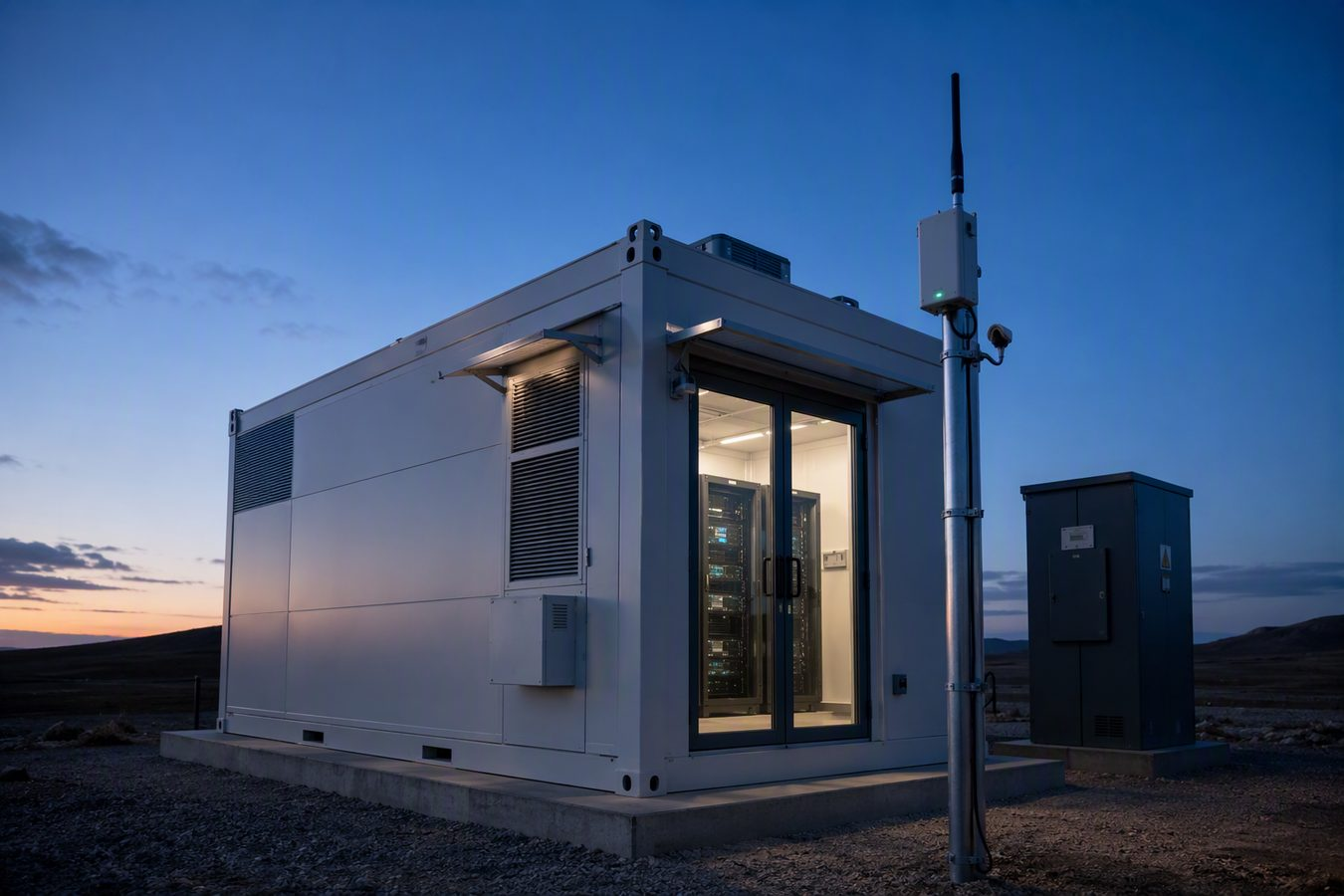
GTHT270 / GTT280 deliver remote environment monitoring with instant push alerts for containerized edge AI sites and unattended rooms — cutting on-site inspection costs dramatically.
Figure 6. Edge AI container site — remote environment monitoring for unattended operation
CRAC performance evaluation, early anomaly detection
Environment Energy
Temperature-field data
Environment-side PUE accounting and audit support
Together these four metric groups build a complete machine-room environment monitoring system covering aisle — duct — rack — outdoor.
4.2 Five Solution Advantages
1
Full-category one-stop supply — temperature & humidity, wireless, and accessories from a single vendor, no multi-vendor integration risk.
2
Strong condition adaptability — wall-mount, duct, micro, outdoor and wireless form factors cover every point type in the room.
3
Standard interfaces — 4–20mA / 0–10V / RS485 natively compatible with FM systems, DCIM and BMS platforms.
4
Wireless retrofit friendly — GTHT270/GTHT290 eliminate cabling work in occupied halls and cross-floor deployments.
5
High accuracy, long-term stability — sensors calibrated for continuous unattended operation in precision environments.
What You Gain
Energy saving — temperature-field data supports supply-air optimization and CRAC setpoint tuning
Precision — rack-level hotspots found and located early, before throttling or downtime
Compliance — continuous environment records support PUE accounting and audit traceability
Peace of mind — automatic alarms plus remote visualization enable centralized multi-site management
Frequently Asked Questions
Can the system integrate with our existing DCIM or BMS?
Yes. All wired sensors output standard 4–20mA, 0–10V or RS485 Modbus signals that connect directly to FM/DCIM/BMS platforms. GSI600 isolators are available where signal isolation is needed. Alternatively, data can reach the cloud via GWM300 4G DTU and be consumed through API.
We can't shut down the room for installation. What are our options?
Two paths: GTHT350 wall-mounted transmitters install on aisle posts and pillars without touching cabinets or power, and GTHT270/GTHT290 wireless sensors need no cabling at all — a typical aisle or duct grid can be completed during a short maintenance window.
How does this help with PUE accounting?
The system provides continuous, traceable temperature and humidity data across aisles, ducts, racks and outdoors — the environment-side dataset required for PUE calculation and environmental audit. GPR200 recorders keep local evidence trails, and cloud history supports remote review.
What's the difference between GTHT350 and GTHT391 — do we need both?
GTHT350 is a wall-mounted transmitter for aisle-level supply/return sensing; GTHT391 is a compact sensor for rack-level inlet monitoring. Aisle-level points find which zone is drifting; rack-level points pinpoint which rack is at risk. High-density rooms benefit from both; lower-density rooms often start with aisle level.
Is wireless data reliable enough for an alarm chain?
GTHT270/GTHT290 use robust low-power wireless with local buffering, and alarms can trigger via both the wireless link and the cloud platform. For critical interlocks (e.g., CRAC linkage), wired RS485/4–20mA points are recommended; wireless is ideal for monitoring grids and retrofits.
Can we monitor outdoor units and fresh-air intake?
Yes. GTHT318 outdoor units measure ambient temperature and humidity for fresh-air and free-cooling decisions, and feed the same platform so environment-side PUE data includes outdoor conditions.