Measure the Pipe From the Outside — No Drilling, No Welding, No Shutdown
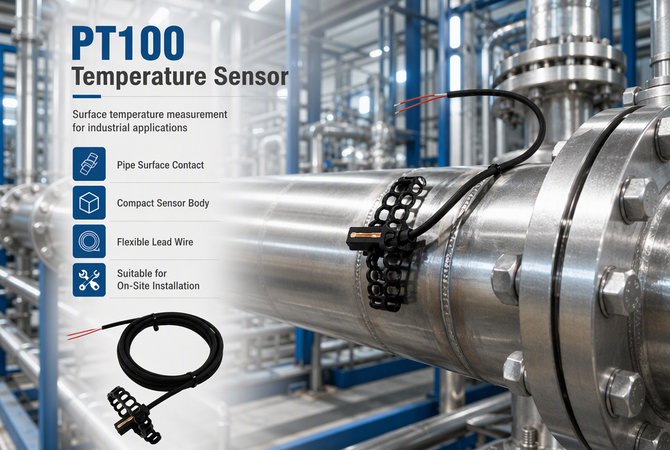
A threaded thermowell needs a hole in the pipe, a weld, a pressure test and a shutdown. On a hygienic line, a small bore or a live process, none of that is acceptable. This sensor straps onto the outside of the pipe instead: a copper contact shoe pulled tight against the wall by two cable ties, a Pt100 element bonded to it, and a flexible lead back to your controller. Installed in minutes, on a line that keeps running.
±0.15 °C
Pt100 Class A at 0 °C
-50~105 °C
standard PVC lead
φ20-110
pipe range, tie-mounted
0 holes
no drilling, no hot work
1-5 m
lead length to order
In one line — a Pt100 pipe-surface sensor with a copper contact shoe and cable-tie mounting, for pipelines, tank walls and equipment surfaces where tapping the wall is impossible, expensive or simply not worth the shutdown.
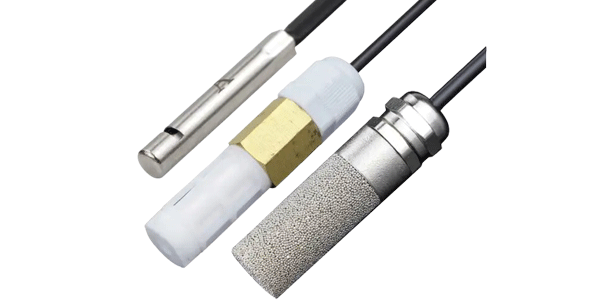
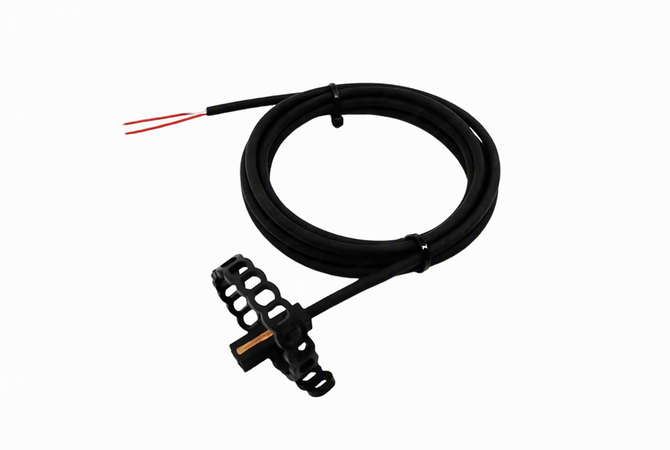
Pt100 strap-on sensor: copper contact shoe, two-tie mounting saddle, black PVC lead, red twin conductors.
Why Clamp-On
Three Situations Where a Thermowell Is the Wrong Answer
01
The pipe cannot be opened
Hygienic CIP lines, pharmaceutical loops, potable water and small-bore stainless all have rules about dead legs, crevices and weld quality. A thermowell boss is a permanent change to a certified system.
A tie-mounted sensor adds nothing to the wetted path
02
The line cannot be stopped
Hot tapping is possible but rarely worth it for a temperature point. If the plant runs 24/7, a shutdown to drill a 20 mm hole costs more than the instrument by an order of magnitude.
Installed on a live line in under five minutes
03
The wall is too thin, or the pipe too small
Below DN25 there is barely room for a well without blocking flow, and thin-wall tube cannot take a boss. Small lines are exactly where clamp-on wins.
Fits φ20–110 mm from the outside, wall thickness irrelevant
Be clear about the trade-off. A clamp-on sensor measures the pipe wall, not the fluid. With the probe insulated over, the deviation from true fluid temperature is typically 0.5–1.5 °C — good enough for monitoring, alarming and trend control, but not for custody transfer or a certified process setpoint. If you need the fluid temperature to a fraction of a degree, use a thermowell. Section 6 explains exactly how to keep the error small.
Key Features
Why the Copper Shoe Is the Whole Design
Cu
Copper Contact Shoe
A solid copper pad sits between the element and the pipe wall — roughly 400 W/m·K against 16 for stainless. It spreads the reading across a wider contact patch, so a slightly uneven tie tension no longer skews the result.
0
No Drilling, No Hot Work
No hole, no weld, no pressure test, no permit. The wetted path and the pipe certification stay untouched — which is what makes it usable on hygienic and potable lines.
φ
Fits φ20–110 mm
The saddled body takes two cable ties, so one part covers small-bore tube through to DN100 pipe. Above that, ties can be daisy-chained rather than stocking another size.
PX
Compact, Low-Profile Body
About 25 mm long and 8 mm proud of the wall, so it fits behind insulation, inside a cabinet or against a wall without a stand-off bracket.
FLX
Flexible PVC Lead
Black PVC, 2 × 0.22 mm², flexible to -30 °C and rated 105 °C. Small enough to route through cable trunking and around pipe supports without kinking.
MIN
On-Site in Minutes
Clean the wall, seat the shoe, pull two ties, insulate over it. No tools beyond a knife and a tie gun — and no reason to take the line out of service.
Pipe surface contact · compact sensor body · flexible lead wire · suitable for on-site installation.
Applications
Pipelines, Tank Walls and Equipment Surfaces
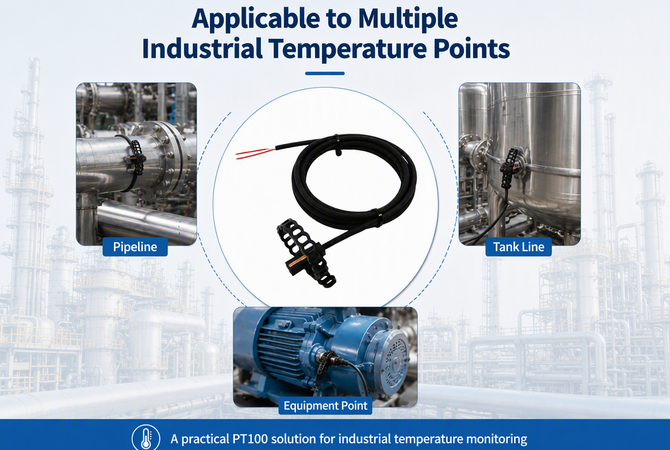
One body, three mounting situations: pipeline, tank line and equipment point.
Process & Utility Pipelines
Supply and return legs, heat-tracing verification, steam and condensate lines. Clamp-on is the standard answer where a thermowell would mean a shutdown or a weld on a certified line.
Tank Walls & Vessel Shells
Surface measurement on tanks where a side-entry sensor is impractical or where the contents are agitated and a probe would be damaged. Ties or banding hold the shoe against the shell.
Pumps, Motors & Bearings
Bearing-housing and casing temperature for condition monitoring. The low-profile body fits in places a threaded sensor cannot, and the PVC lead survives oil mist and vibration.
HVAC & Building Services
Chilled-water and heating circuits, riser balancing and retrofit metering where the pipework is already closed and nobody is going to drain a riser for a sensor.
Build Detail
Three Things to Look At
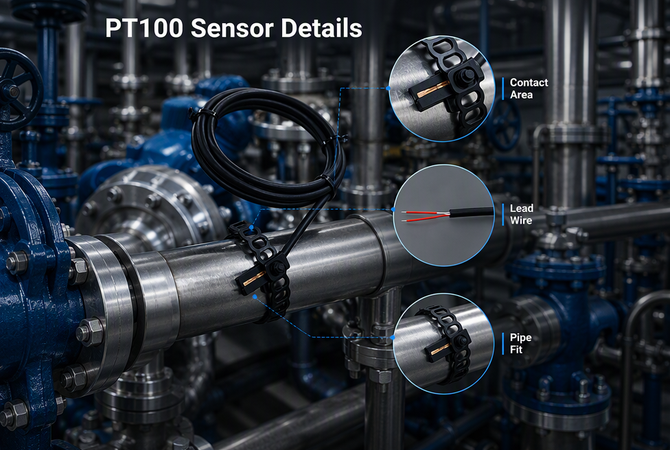
Contact area · lead wire · pipe fit.
Contact Area
The copper shoe is the sensing surface. It is deliberately wider than the element so that heat from the pipe wall converges on the bead from a representative patch, not from a single point. Seat it against bare metal — paint and rust scale act as insulation.
Lead Wire
Two red conductors in a black PVC jacket, pre-stripped at the far end. Two-wire is standard; three-wire and four-wire versions use the same body when lead resistance matters on long runs.
Pipe Fit
The saddle has two tie slots moulded in line with the shoe, so tension pulls the copper flat against the wall instead of tilting it. That geometry is why the reading stays repeatable when a fitter installs it in a hurry.
Installation
Four Steps — the Fourth One Decides the Accuracy
1
Pick the Point
At least 5 pipe diameters from a valve, bend or weld, and clear of supports. On a horizontal pipe use the 3 or 9 o'clock side — the top collects air, the bottom collects sediment.
2
Clean to Bare Metal
Remove paint, rust and scale from a patch slightly larger than the shoe, then wipe it clean. A thin film of thermal grease helps on rough or pitted surfaces.
3
Seat and Tension
Hold the shoe flat on the cleaned patch and pull both ties until the body cannot rock. Two ties in line, not crossed — crossing tilts the shoe and lifts one edge off the wall.
4
Insulate Over It
Reinstate the pipe insulation over the sensor, with no gap and no compressed void. This is the step that turns a 6 °C error into a 1 °C error.
The biggest accuracy gain is not in the sensor — it is the insulation you put back over it. A clamp-on sensor that is left exposed reads a blend of pipe wall and ambient air. On a 60 °C line in a 20 °C plant room, an uninsulated probe can sit 5–10 °C low; cover it properly and the same probe tracks the fluid within about 1 °C. If a customer reports "the clamp-on reads low", nine times out of ten the insulation was never reinstated.
Accuracy Reality
What a Surface Reading Actually Tells You
The element is accurate to ±0.15 °C. The measurement is only as good as the thermal path from fluid to element, and that path runs through the pipe wall, the contact patch and whatever insulation covers the joint. Here is what to expect in practice.
Site condition
Typical deviation from true fluid temperature
Probe insulated over, flowing fluid, metal pipe
0.5–1.5 °C
Probe insulated but poorly seated (paint, scale)
1–3 °C
Probe left exposed, indoor, still air
3–8 °C
Probe exposed, outdoor, windy
8–15 °C or worse
Plastic pipe or lined pipe
Add 2–5 °C — the wall itself is the insulator
Static fluid in the line
Unreliable — no convective mixing to the wall
Indicative figures for steady-state conditions. Actual deviation depends on pipe material, wall thickness, flow rate, insulation quality and ambient conditions. For a certified process value, use a thermowell.
Where clamp-on is the right instrument. Trend monitoring, high/low alarms, heat-tracing verification, bearing watch, HVAC balancing and any retrofit where the pipe cannot be opened. Where the number has to stand up in an audit or a custody transfer, it does not replace a thermowell — and we will tell you so before you order.
Specifications
Technical Data
Sensor element
Pt100 platinum RTD, Class A per IEC 60751 (Class B on request)
Accuracy
±0.15 °C at 0 °C · ±0.30 °C at 100 °C (Class A)
Measuring range
-50 to +105 °C with PVC lead; -50 to +180 °C with silicone lead
Contact shoe
Solid copper pad, approx. 20 × 8 mm
Body
Glass-filled nylon saddle, approx. 25 × 12 × 8 mm, two tie slots
Pipe range
φ20–110 mm with two cable ties; larger on request
Lead wire
Black PVC, 2 × 0.22 mm², 1 m standard; 2 / 3 / 5 m to order
Wiring
2-wire standard; 3-wire and 4-wire on request
Termination
Bare wire, tinned, ferrule or connector on request
Response time
τ0.9 ≈ 25 s on an insulated DN50 pipe (surface measurement is inherently slower than immersion)
Insulation resistance
≥ 100 MΩ at 500 VDC
Ingress protection
IP65 body; not for immersion
Mounting hardware
Supplied with 2 × stainless cable ties; banding available for tank shells
Compliance
RoHS / REACH; calibration certificate optional
Values describe the standard configuration. Element class, lead material, length and termination are confirmed against each order before production.
Wiring & Compatibility
Two Wires, or Three?
A Pt100 changes resistance by about 0.385 Ω per °C, so the resistance of the lead itself is part of the measurement. On a short run it does not matter; on a long one it does.
Wiring
How it works
When to choose it
2-wire
Lead resistance adds directly to the reading
Leads under about 5 m, or where ±1 °C is acceptable
3-wire
One compensating leg cancels most lead error
The industrial default — long runs, transmitters, PLC cards
Rule of thumb: 0.1 mm² copper is about 0.19 Ω per metre of conductor. A 10 m two-wire run adds roughly 3.8 Ω — about 10 °C of apparent error. If your run is that long, specify three-wire.
Pairing with your instrument. Any controller, transmitter, PLC card or data logger with a Pt100 input will read this sensor — but the input must be configured for Pt100, not for a thermocouple or an NTC. Two-, three- and four-wire inputs are not interchangeable: match the sensor's wiring to the input's wiring.
OEM & Customisation
Adapted to Your Pipe, Not Ours
We build this sensor for instrument distributors, OEM skids and plant maintenance groups, so the parts that vary are the ones your installation actually needs.
Element — Pt100 Class A standard; Class B, Pt1000 or NTC on the same body
Wiring — 2-wire, 3-wire or 4-wire, with the lead colour code you specify
Lead — PVC to 105 °C or silicone to 180 °C, 1–5 m, straight or coiled
Termination — bare, tinned, ferrule, M12 connector or your own plug
Mounting — standard ties, stainless banding for tanks, or an adhesive pad variant
Branding — laser marking, printed lead, labelled bag and retail packaging
Trial orders welcome. Send us the pipe diameter, the medium temperature and your controller input type, and we will confirm the element class, wiring and lead length — samples before production.
FAQ
Questions Engineers Ask About Clamp-On Sensing
How accurate is a clamp-on sensor compared with a thermowell?
The element itself is ±0.15 °C, but the measurement is limited by the thermal path. With the probe insulated over and good contact on a metal pipe, expect 0.5–1.5 °C deviation from true fluid temperature. A thermowell reaches ±0.2–0.5 °C. Choose clamp-on for monitoring and alarms, a thermowell for certified process values.
Will it work on plastic or lined pipe?
It will read, but the wall becomes part of the insulation — add 2–5 °C of deviation and expect a slower response. On plastic pipe the sensor is best used for trend and alarm rather than absolute temperature.
Do I have to insulate over the sensor?
For any meaningful accuracy, yes. An exposed clamp-on probe reads a blend of pipe wall and ambient air and can sit 5–10 °C low in a cool plant room. Reinstating the insulation over the sensor is the single largest accuracy improvement available.
Can it be used on a hygienic or potable water line?
Yes — that is one of its main advantages, because nothing enters the wetted path and no weld is made. Confirm that the external body material suits your washdown chemicals, and route the lead away from CIP spray.
What pipe sizes does one unit cover?
φ20–110 mm with the two supplied ties. Larger pipes work by daisy-chaining ties or using stainless banding; below φ20 the saddle starts to bridge the curvature, so ask us about the small-bore variant.
Does it work on a pipe with no flow?
Poorly. With static fluid there is no convective mixing to carry heat to the wall, so the reading drifts toward ambient. Clamp-on sensing assumes flow; for static contents use an immersion probe.
Two-wire or three-wire?
Two-wire for leads under about 5 m. Beyond that, lead resistance becomes visible — roughly 10 °C of error at 10 m of 0.1 mm² copper — so specify three-wire, or four-wire for calibration work.
Need a temperature point without opening the pipe?
Send us the pipe diameter, medium temperature and your controller input. We will confirm the element class, wiring and lead length — and tell you honestly if a thermowell is the better answer.
Have questions? Need a quote? We are ready to help! Fill out the form and a member of our sales team will contact you to discuss your requirements. You can also give us a call at (86)177-9158-1665.