Magnetic NTC Surface Sensor for Energy Storage Cabinets
Temperature Feedback From a Cabinet Surface — No Drilling, No Adhesive, No Shutdown
In a battery energy storage cabinet, the places worth watching are busbar joints, contactor housings, cable terminations and panel sections near a heat source. They are also the places you cannot drill into once the system is energised. This sensor attaches magnetically instead: an Ø18 mm stainless puck with a flat sensing face and an NTC 100K element, held flat against a ferromagnetic cabinet wall by its own permanent magnet. It can be fitted in seconds, moved when the thermal map changes, and lifted off for inspection without leaving a mark.
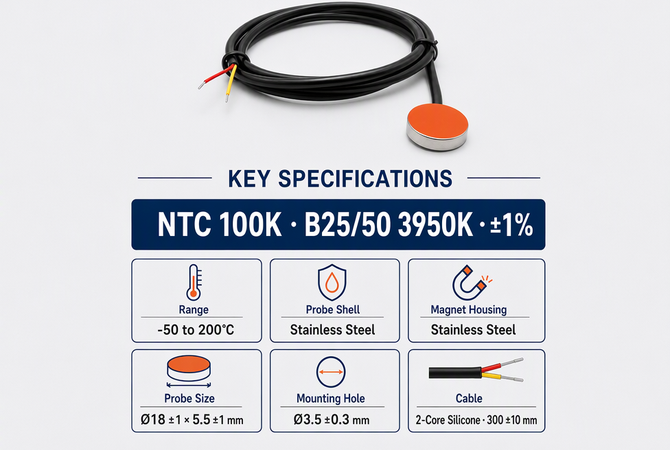
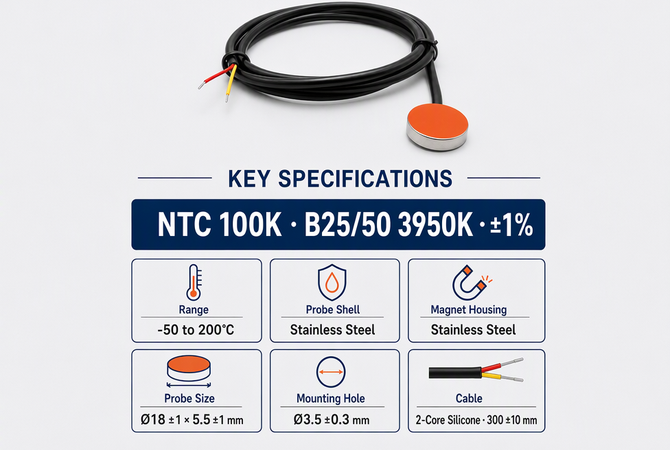
100K B3950
NTC element, ±1 % tolerance
-50~200 °C
operating range
Ø18 × 5.5
mm stainless magnetic housing
0 holes
no adhesive, no hot work
300 mm
2-core silicone lead
In one line — a compact magnetic NTC 100K B3950 surface probe that feeds cabinet surface temperature back to a BMS, EMS, PLC or temperature controller, for hot-spot detection and trend monitoring in energy storage and electrical cabinets.
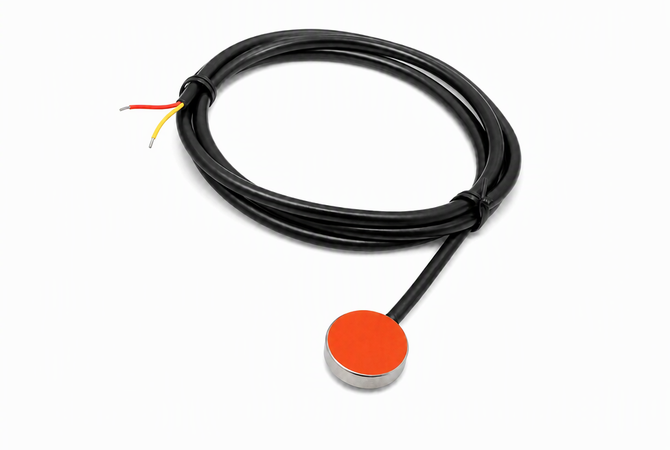
Standard supply: Ø18 × 5.5 mm stainless magnetic probe, flat sensing face, 300 mm 2-core silicone cable, red / yellow tinned leads.
Why Magnetic Mounting
Four Ways to Attach a Surface Sensor — Only One Lets You Move It
On an already-commissioned cabinet, the mounting method is often a bigger decision than the sensor itself. Here is how the four common options compare.
The practical value is during commissioning. A thermal map is rarely right the first time: a point that looked interesting on the drawing turns out to sit in cool airflow, and the real hot spot is 200 mm away. A magnetic probe moves in seconds with no residue and no rework — which is why it is the preferred choice for surveys, pilot racks and retrofit cabinets.
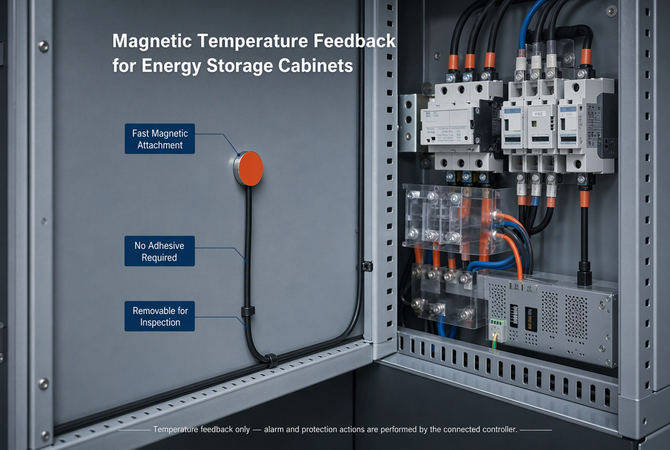
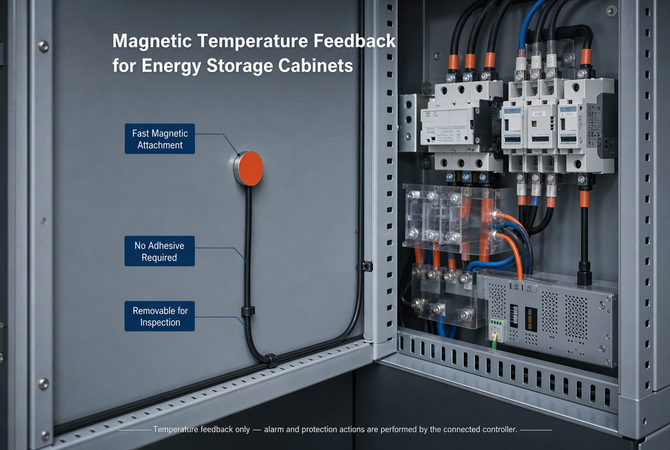
Fast magnetic attachment · no adhesive required · removable for inspection. Temperature feedback only — alarm and protection actions are performed by the connected controller.
Key Features
Six Design Choices That Matter Inside a Cabinet
100K
NTC 100K · B25/50 3950K · ±1 %
A widely used curve for BMS, EMS and PLC temperature inputs. Tight ±1 % tolerance keeps one probe comparable with the next across a multi-cabinet installation.
MAG
Stainless Steel Magnet Housing
A permanent magnet inside a stainless steel shell holds the probe flat against a ferromagnetic panel — no adhesive, no bracket, no tools, no cure time.
Ø18
Flat Ø18 mm Sensing Face
A broad, flat contact patch rather than a pointed tip. More contact area on a painted or slightly uneven panel means a steadier reading and less sensitivity to fitter technique.
Ø3.5
Auxiliary Mounting Hole
A Ø3.5 ±0.3 mm hole gives a mechanical fallback: screw or rivet the probe to non-magnetic panels, or add a safety tether where vibration is a concern.
SI
2-Core Silicone Cable, 300 mm
Silicone stays flexible across the full -50 to 200 °C range and routes cleanly along a cabinet frame. Supplied at 300 ±10 mm; longer lengths to order.
2×
Dual Heat-Shrink Reinforcement
Two staggered heat-shrink sleeves at the probe exit absorb the pull and bend that kill single-jacket probes when a cable is dressed inside a crowded cabinet.
Key specifications as supplied. Values in the table below are taken from this sheet — confirm any deviation against your order before publication.
Build Detail
Six Points, Photographed Close Up
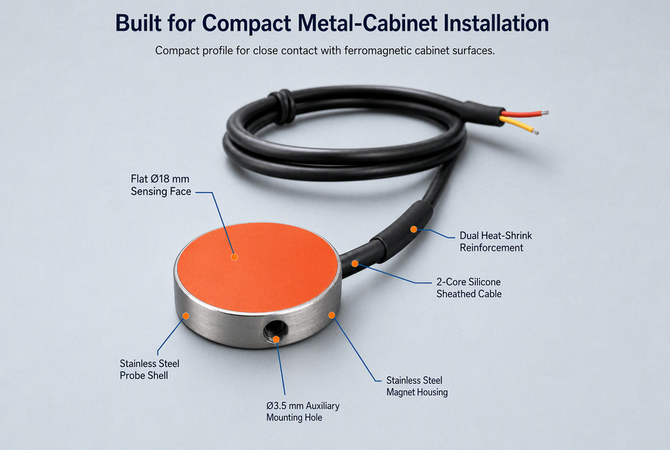
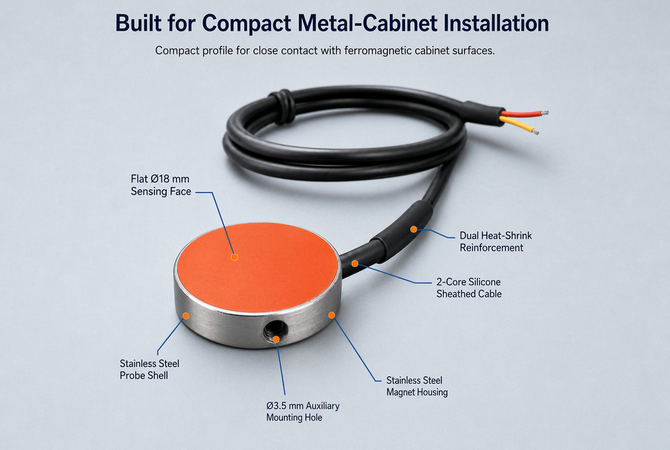
Built for compact metal-cabinet installation: a low profile that keeps the sensing face in close contact with ferromagnetic cabinet surfaces.
Flat Sensing Face & Probe Shell
The Ø18 mm orange face is the measurement surface; the NTC element sits directly behind it inside a stainless steel shell. Wipe the panel clean before attaching — dust, paint flakes and an air gap all read as insulation.
Stainless Steel Magnet Housing
The magnet is enclosed in the stainless body, so there is nothing to corrode and no exposed adhesive to degrade in a warm cabinet. Pull-off force depends on panel thickness and coating — check the substrate in Section 8.
2-Core Silicone Cable & Dual Heat-Shrink
Two cores, red and yellow, tinned and stripped at the far end. The staggered heat-shrink sleeves spread the bending load over a longer length instead of concentrating it at the shell exit.
Ø3.5 mm Auxiliary Mounting Hole
A through-hole for mechanical fixing on non-magnetic panels, or for a retention clip where the cabinet is subject to vibration or transport. Magnetic mounting needs no hole at all — this is the fallback, not the default.
Applications
Where a Surface Point Earns Its Place
Electrical & Battery Cabinet Panels
Steel panel sections near a heat source, where a slowly rising surface temperature is the first visible sign of a developing problem. One probe per zone gives the BMS a surface-trend input alongside its cell measurements.
Contactor & Relay Housings
Contactors, relays and switch-disconnectors warm up as contacts age. A magnetic probe on the housing tracks that rise over months without opening the device or interrupting the circuit.
Busbar Joints & Cable Terminations
Loose torque shows up as local heating long before it becomes a fault. Place the probe on the enclosure wall closest to the joint — not on the live conductor — and trend it against the load current.
PCS, Inverter & Retrofit Racks
On cabinets already in service, drilling is often prohibited by warranty or site rules. Magnetic mounting adds a monitoring point with no modification to a certified assembly and no shutdown.
Surface temperature is a trend signal, not a cell measurement. These are enclosure-wall and housing temperatures. They are excellent for detecting a change and locating a hot spot; they are not a substitute for the cell, module or coolant temperatures measured by the BMS itself.
Installation
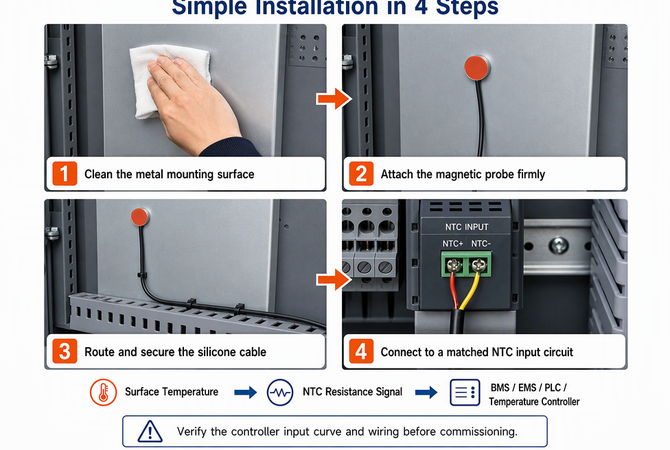
Four Steps — and One Check Before Energising
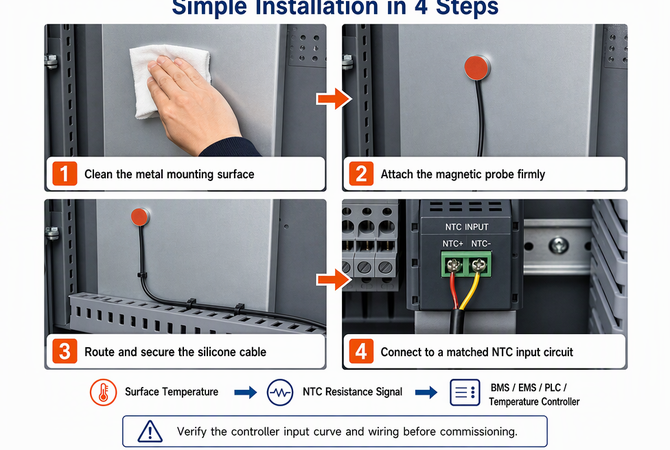
Clean the surface · attach the probe · route and secure the cable · connect to a matched NTC input. Verify the controller input curve and wiring before commissioning.
1
Clean the Surface
Wipe the panel to remove dust, oil and loose paint over an area slightly larger than the probe. Good metal-to-metal contact decides the reading; a flake of scale under the face becomes an air gap.
2
Attach the Probe
Seat the flat face squarely on the cleaned patch and let the magnet pull it down. Confirm it cannot be rocked by hand. On a vibrating cabinet, use the Ø3.5 mm hole for a retaining clip.
3
Route and Secure the Cable
Dress the silicone lead along the cabinet frame away from busbars, sharp edges and moving parts. Leave a small service loop at the probe so a later inspection does not pull on the strain relief.
4
Connect to a Matched NTC Input
Land the two cores on the NTC+ / NTC- terminals of the BMS, EMS, PLC or controller. NTC elements have no polarity, so either way round reads the same — but the input curve must be 100K B3950.
The Signal Chain
Surface Temperaturecabinet panel or housing
→
NTC Resistance Signal100 kΩ at 25 °C, B3950
→
BMS / EMS / PLCor temperature controller
→
Alarm & Protectionexecuted by the controller
Verify before commissioning. Confirm that the controller input is configured for NTC 100K B3950 and that both cores are on the same input pair. A mismatch does not produce an obvious fault — it produces a plausible but wrong temperature, which is worse. Compare the displayed value with a reference thermometer at ambient before the cabinet goes into service.
Scope of Supply
Temperature Feedback Only — This Is Not a Protection Device
Important — read before specifying This sensor is a passive NTC element. It outputs a resistance that changes with the temperature of the surface it touches. It does not generate alarms, trip a contactor, isolate a battery rack, suppress a fire or make any safety decision. All alarm thresholds, logic, interlocks and protective actions are defined and executed by the connected BMS, EMS, PLC or temperature controller — and by the system integrator who configured them. The same applies to every figure and application described on this page.
What it does
Report cabinet surface temperature as an NTC resistance signal; reveal a developing hot spot; support trend logging, alarm inputs and commissioning surveys on metal enclosures.
What it does not do
Measure cell or module internal temperature; detect thermal runaway directly; act as a certified safety sensor; replace the BMS' own temperature channels, gas detection or fire suppression system.
For safety-critical functions — cell temperature monitoring, runaway detection, fire alarm or emergency isolation — use sensors and logic qualified to the relevant system standard, and follow the cabinet manufacturer's and integrator's protection design. We are happy to supply the surface-monitoring points around that system, but we will not represent this probe as a safety device.
Mounting Substrate
The Magnet Needs a Ferromagnetic Surface
This is the single most common installation surprise. A magnet holds firmly to carbon steel, but several materials used in energy storage cabinets are not magnetic at all. Check the panel material before ordering a magnetic-only installation.
Cabinet surface
Magnetic hold
What to do
Carbon steel, painted or powder-coated
Good
Standard magnetic mounting. Clean the surface; thin coatings are fine, thick ones reduce pull-off force.
Ferritic / martensitic stainless (e.g. 430)
Good
Standard magnetic mounting.
Austenitic stainless (304 / 316)
None or very weak
Use the Ø3.5 mm auxiliary hole with a screw or rivet, a steel mounting pad, or thermal adhesive.
Aluminium, copper, composite panel
None
Mechanical fixing through the auxiliary hole, or an adhesive-mounted variant — tell us at enquiry stage.
Thick powder coat / insulation / liner
Reduced
Treat the coating as an air gap: it weakens the hold and slows the thermal response. Prefer a bare-metal patch.
Not sure what the panel is made of? Put a ordinary magnet on it before specifying. If it does not grip firmly, the probe will not either — and a probe that slowly slides down a panel reads the air, not the cabinet. In that case use the auxiliary mounting hole or ask us for the adhesive variant.
Before You Order
100K B3950 Is the Default — Make Sure It Is Yours
"100 kΩ" describes one point on the curve, not the curve itself. Two 100 kΩ NTCs with different beta values agree at 25 °C and diverge by several degrees at 0 °C or 60 °C. The controller input curve must match the probe.
Curve
R at 25 °C
Beta
Typical use
NTC 100K B3950
100 kΩ
3950 K
This sensor — general BMS / EMS / PLC temperature inputs
NTC 100K B3977 / B3435
100 kΩ
3977 / 3435 K
Brand-specific controllers, HVAC
NTC 10K B3950
10 kΩ
3950 K
Underfloor heating, common thermostat inputs
PT100 / PT1000 RTD
100 / 1000 Ω
—
Industrial RTD inputs, building management
How to confirm in one minute. Look for "NTC 100K", "100 kΩ @ 25 °C" and "B 3950" in the controller's input specification or configuration menu. If only the resistance is stated, ask the manufacturer for the beta — or send us the controller model and we will match it. We build 10K, 50K, other beta values and PT1000 on the same magnetic body.
Wiring is simple, but not optional. An NTC is a pure resistance with no polarity, so the red and yellow cores can be landed either way round. Keep both on the same NTC input pair, away from mains terminals, and verify the displayed ambient reading before the cabinet is energised.
Specifications
Technical Data
Sensor element
NTC thermistor, 100 kΩ at 25 °C
Beta value (B25/50)
3950 K
Tolerance
±1 %
Operating range
-50 to +200 °C
Sensing face
Flat, Ø18 mm
Probe shell
Stainless steel
Magnet housing
Stainless steel with internal permanent magnet
Probe dimensions
Ø18 ±1 × 5.5 ±1 mm
Auxiliary mounting hole
Ø3.5 ±0.3 mm
Cable
2-core silicone sheathed, black
Cable length
300 ±10 mm standard; longer lengths to order
Cable exit
Dual heat-shrink reinforcement
Termination
Bare tinned wire, red / yellow cores, pre-stripped
Output signal
Passive NTC resistance, no polarity
Mounting
Magnetic attachment to ferromagnetic surfaces; Ø3.5 mm hole for mechanical fixing
Compatible input
BMS / EMS / PLC / temperature controller with NTC 100K B3950 input
Function
Surface temperature feedback only — alarms and protective actions are performed by the connected controller
Values describe the standard configuration shown on the specification sheet. Resistance, beta value, cable length, termination and housing options are confirmed against each order before production.
OEM & Customisation
Specified Around Your Controller and Your Cabinet
We build this probe for BESS integrators, cabinet manufacturers and instrumentation distributors, so the variable parts are the ones your installation actually needs.
Curve — NTC 100K B3950 standard; 10K, 50K, other beta values, PT1000 on the same body
Cable — 300 mm standard, 0.5–5 m to order; silicone, PVC or PTFE jacket
Termination — bare tinned wire, ferrule, JST / Molex housing, M12 or your own connector
Housing — Ø18 standard, other diameters, face colour, magnet strength, with or without auxiliary hole
Non-magnetic panels — adhesive-mounted variant, steel mounting pad or screw-fixed version
Documentation — resistance / beta test report per batch, RoHS / REACH declaration
Trial orders welcome. Send the controller model (or the NTC curve), the cabinet panel material and the cable length you need. We will confirm the match and build samples before a production run.
FAQ
Questions From Integrators and Cabinet Builders
Does this sensor trigger an alarm or shut down the system?
No. It is a passive NTC element that outputs temperature-dependent resistance. It provides temperature feedback only; all alarm thresholds, interlocks and protective actions are performed by the connected BMS, EMS, PLC or controller. It is not a safety device and should not be specified as one.
Will the magnet hold on my cabinet panel?
Only on ferromagnetic surfaces — carbon steel and ferritic stainless steels. Austenitic stainless (304 / 316), aluminium and composite panels are non-magnetic, so the probe will not hold. Use the Ø3.5 mm auxiliary mounting hole with a screw or rivet, a steel mounting pad, or ask for the adhesive-mounted variant.
Will it work with my BMS or PLC?
Yes, if the temperature input is configured for NTC 100K B3950. Check the controller specification for "100 kΩ @ 25 °C" and beta 3950 K. If it uses 10K, another beta value or a Pt1000 input, tell us the model and we will build a matching version.
Does it measure the battery cell temperature?
No. It measures the temperature of the metal surface it is attached to — a cabinet panel, contactor housing or enclosure wall. It is used for hot-spot detection and trend monitoring, not as a cell or module temperature input. Cell temperature must come from the BMS' own sensors.
Can I move the probe after installation?
Yes — that is the main advantage of magnetic mounting. Lift it off, clean the new patch and reattach. There is no adhesive residue, no hole and no cable rework beyond re-dressing the lead. It is particularly useful during commissioning thermal surveys.
Is the cable polarity-sensitive?
No. An NTC is a pure resistance, so the red and yellow cores can be connected either way round to the NTC+ / NTC- terminals. Keep both cores on the same input pair and verify the ambient reading at commissioning — a curve mismatch reads plausibly but wrongly.
What is the maximum temperature?
-50 to +200 °C for the probe and silicone lead, which is far above normal cabinet surface temperatures. Note that the magnet and the panel coating also have their own limits; sustained high temperature is not a normal operating condition for an energy storage cabinet.
Can I get a longer cable or a different connector?
Yes. Cable length from 0.5 m to 5 m, and terminations including ferrules, JST / Molex housings, M12 or your own connector and pinout. We also supply adhesive-mounted and screw-fixed variants for non-magnetic panels.
Adding surface temperature points to a cabinet or a rack?
Send the controller model, the panel material and the cable length. We will confirm the NTC curve and mounting method, quote against your volume and build samples before production.
Have questions? Need a quote? We are ready to help! Fill out the form and a member of our sales team will contact you to discuss your requirements. You can also give us a call at (86)177-9158-1665.