A Pt100 BBQ Temperature Probe Built for the Heat, the Grease and the Season
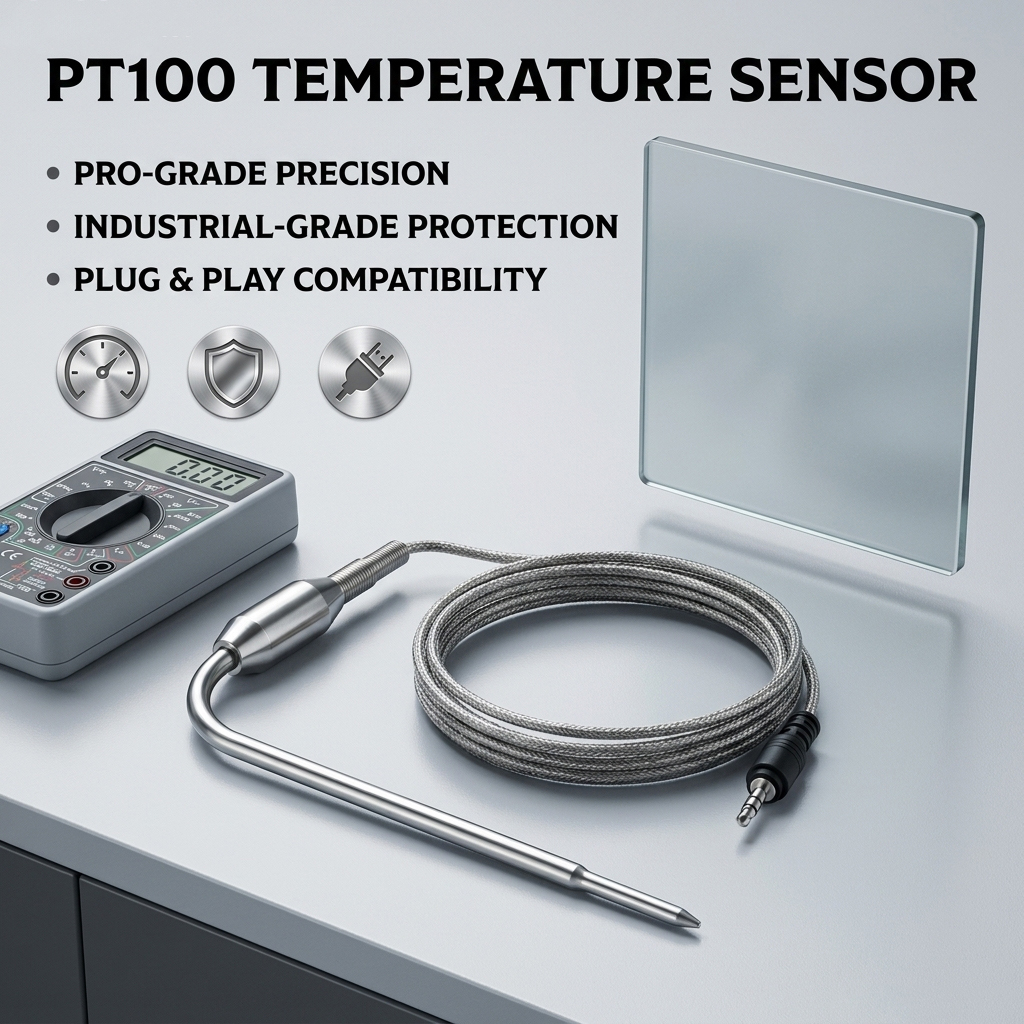
Most BBQ probes die the same way: the cable hardens, the joint kinks, the reading drifts, and by August the pitmaster is guessing again. This probe is built the other way around — a Pt100 platinum element that does not drift, a 316L stainless shaft, an aviation-grade aluminium strain relief at the point where every other probe breaks, and a stainless braided cable that shrugs off 300 °C radiant heat.
±0.15 °C
Pt100 Class A accuracy at 0 °C
-50~300 °C
continuous probe range
316L
food-grade stainless shaft
3.5 mm
reinforced mono plug
1 m
braided cable, custom to 5 m
In one line — a drop-in Pt100 meat probe for offset smokers, pellet grills, kamado cookers and commercial rotisseries, available in 2-wire, 3-wire and 4-wire configurations with custom shaft length, cable length and connector for OEM programmes.
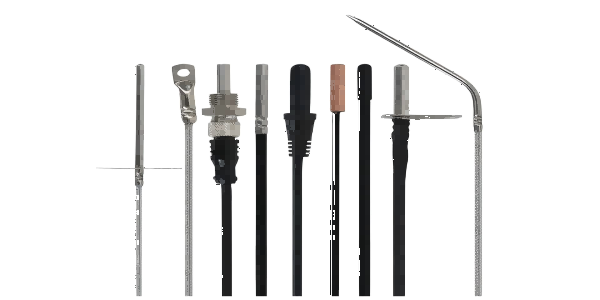
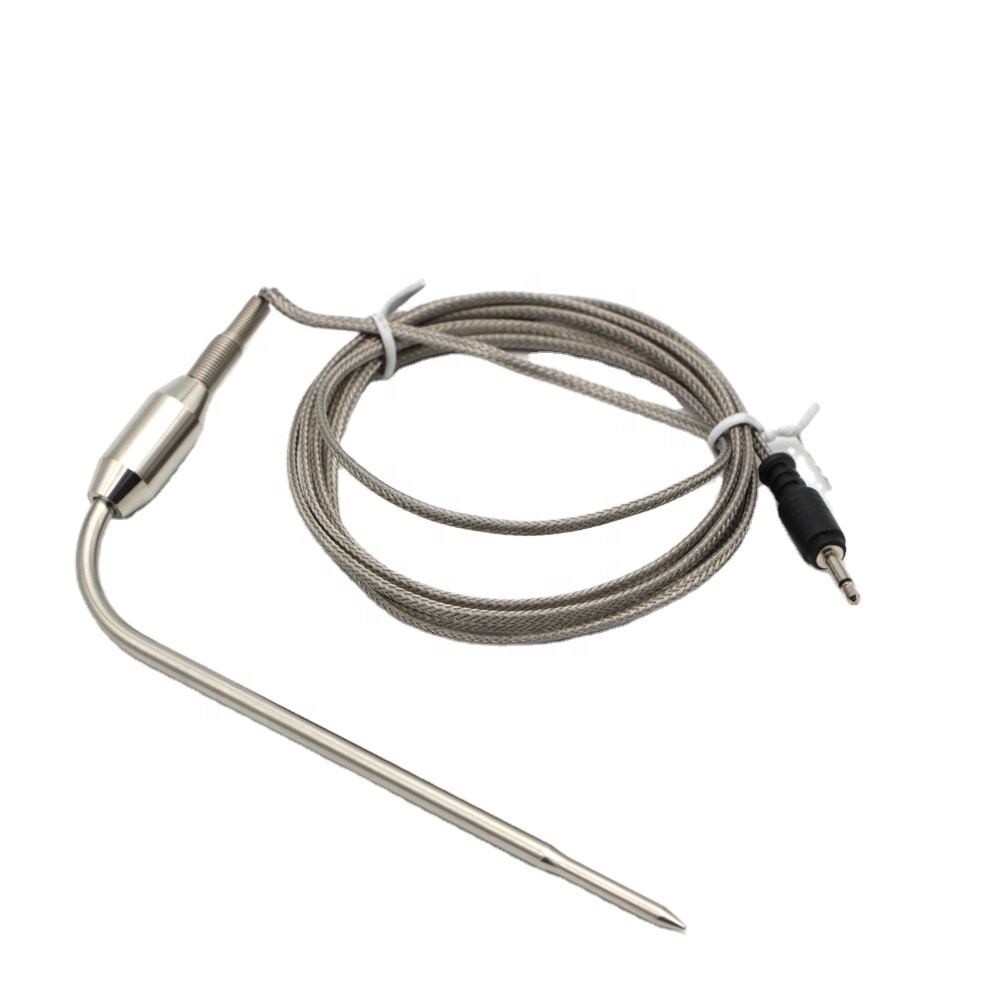
Standard configuration: 6 mm × 120 mm 316L shaft, aviation-grade aluminium joint, 1 m stainless braided cable, 3.5 mm mono plug.
Failure Analysis
Where Ordinary BBQ Probes Fail — and What We Changed
We rebuild probes for a living, and the returns tell the same four stories every season. Each one is an engineering decision, not bad luck.
01
The probe-to-cable joint snaps
Almost every failed probe dies here. The shaft is rigid, the cable is flexible, and all the bending load concentrates in a few millimetres of heat-shrink. Pull the probe out of a brisket at 95 °C and the conductors work-harden and break.
Fixed by a machined aviation-aluminium joint with a crimped, sealed transition
02
The cable cooks before the meat does
Silicone jackets are rated around 200 °C and lose flexibility fast. Lay the cable across a hot grate or let it touch the fire ring in a kamado and the jacket embrittles, cracks, and exposes the shield.
Fixed by a stainless steel braided jacket rated to 300 °C
03
The reading drifts after a few cooks
NTC thermistors are cheap and reasonably accurate when new, but they are non-linear, batch-dependent and slowly drift with thermal cycling. Two probes in the same brisket can read 6 °C apart — and neither is traceable.
Fixed by a Pt100 platinum RTD: linear, interchangeable, no calibration curve to load
04
The plug corrodes and the reading jumps
Grease, steam and washing-up water reach the plug, oxidise the contacts, and the controller starts showing open-circuit spikes mid-cook.
Fixed by an industrial-grade moulded boot with strain relief and a plated mono plug
Key Features
Six Things That Matter When the Lid Comes Down
Pt
Pt100 Class A Element
Platinum RTD to IEC 60751, ±0.15 °C at 0 °C. Linear across the whole cooking range, so the controller needs no thermistor table and no per-probe calibration.
316
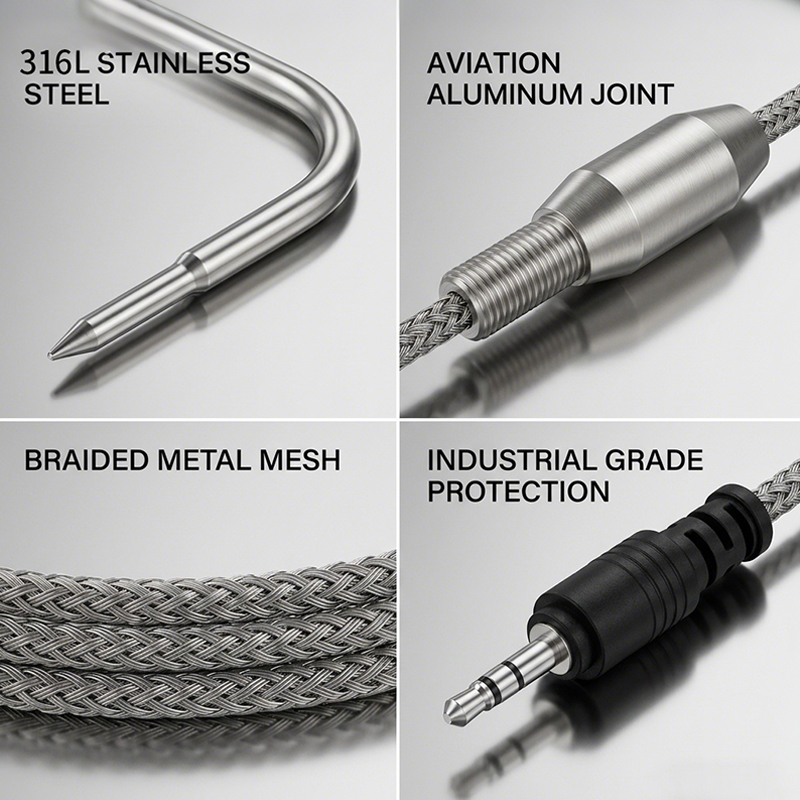
316L Stainless Shaft
Food-contact grade, molybdenum-stabilised for chloride and acid resistance. No plating to flake, no galvanic reaction with brine or rub.
AX
Aviation Aluminium Joint
CNC-turned alloy body takes the bending load away from the conductors — the single highest-value upgrade on a probe that gets pulled in and out all day.
SS
Braided Metal Mesh Cable
Stainless over-braid resists 300 °C radiant heat, cuts from grate edges, and chewing from anything with teeth. Flexible down to -50 °C for cold-smoke and freezer work.
IP
Industrial-Grade Plug Boot
Moulded boot with a double strain relief and a plated 3.5 mm mono (TS) plug. Rated IP67 at the shaft-to-cable joint for washdown between cooks.
OEM
Plug & Play, Then Custom
Standard units drop straight into Pt100 controllers. For brands: your shaft length, cable length, connector, laser marking and retail packaging.
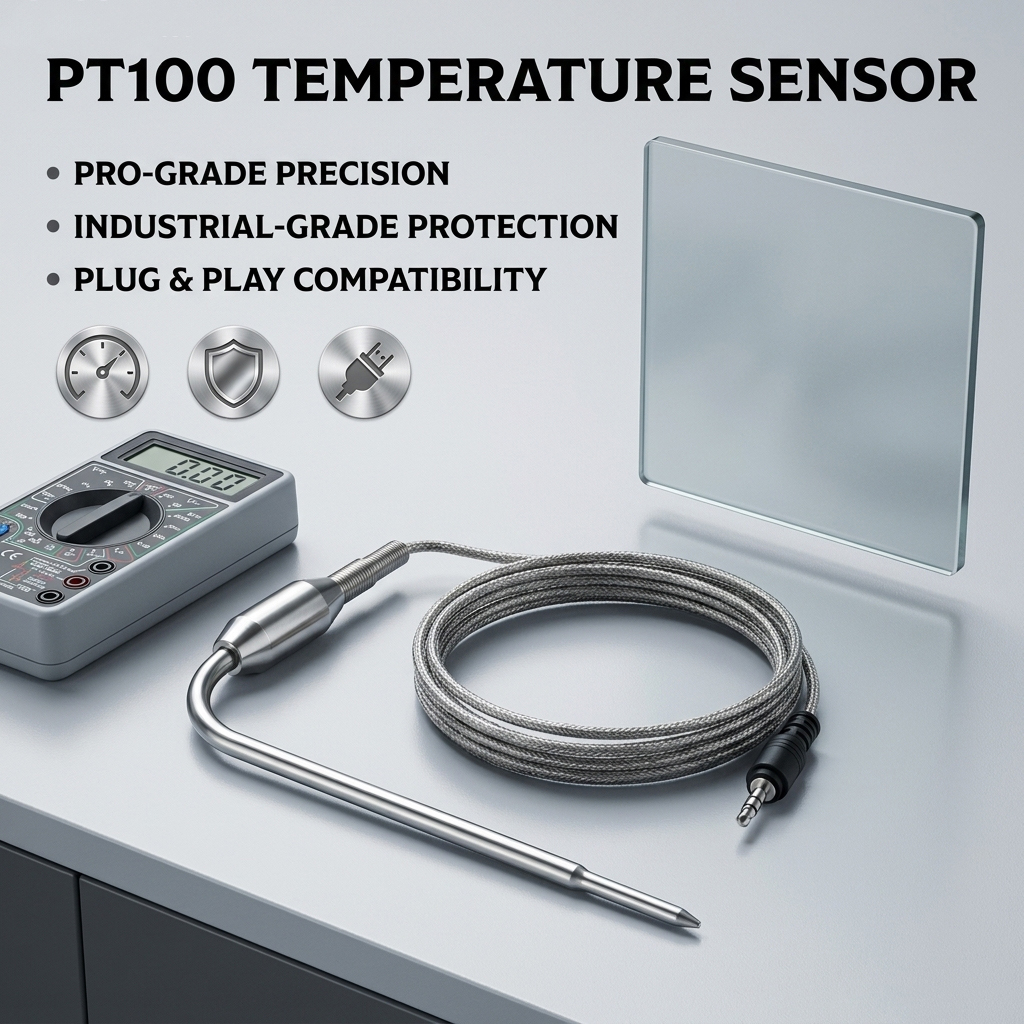
Pt100 output is a clean resistance: roughly 100 Ω at 0 °C, 110 Ω at 26 °C, 138.5 Ω at 100 °C. Verifiable with any decent multimeter — no proprietary tester required.
Ø6 mm, 120 mm standard, with a 30° ground tip that enters muscle without tearing the crust. Wall thickness is held at 0.8 mm so the element sits close to the surface and responds in seconds, not minutes. Available 50–300 mm to order.
Aviation Aluminium Joint
Machined from 6061 alloy, anodised, then crimped over the cable with a high-temperature seal. It is the reason the probe survives being lifted out of a 120 °C smoker by the cable a thousand times.
Braided Metal Mesh Cable
Stainless over-braid on a fibreglass core with PTFE-insulated conductors. 300 °C continuous, abrasion-resistant, and it will not melt onto a hot grate the way silicone does.
Industrial-Grade Plug Protection
Two-stage moulded boot absorbs pull and side-load. 3.5 mm mono (TS) plug as standard; 2.5 mm mono, bare wire, ferrule or M12 connector on request.
Specifications
Technical Data
Sensor element
Pt100 platinum RTD, Class A per IEC 60751, 3850 ppm/K
Accuracy
±0.15 °C at 0 °C · ±0.30 °C at 100 °C (Class A)
Measuring range
-50 to +300 °C continuous; short excursions to +350 °C
Probe material
316L stainless steel, food-contact grade
Probe dimensions
Ø6.0 mm × 120 mm standard (50–300 mm on request)
Joint / strain relief
6061 aviation aluminium alloy, anodised, crimped and sealed
Cable
Stainless steel braided jacket over PTFE-insulated conductors, 1.0 m standard (0.5–5 m on request)
Cable temperature rating
-50 to +300 °C
Connector
3.5 mm mono (TS) plug standard; 2.5 mm mono / bare wire / ferrule / M12 optional
Wiring
2-wire standard; 3-wire and 4-wire on request
Response time
τ0.9 ≈ 6 s in stirred water (standard 6 mm shaft)
Ingress protection
IP67 at the shaft-to-cable joint; plug is splash-resistant, not submersible
Insulation resistance
≥ 100 MΩ at 500 VDC
Durability
1.5 m drop tested; 10–500 Hz vibration sweep; 500 h at 250 °C ageing
Values describe the standard configuration. Final datasheet, tolerances and test reports are issued against each order — send us your target specification and we will confirm capability before you commit.
Before You Buy
Pt100 or NTC? Check Your Controller First
This is an important point, and we would rather say it on the page than in a return form: a Pt100 probe is not a drop-in replacement for an NTC thermistor probe. The two have different resistance curves, and a controller expecting NTC will read a Pt100 probe as a fault or a wildly wrong number.
Property
Pt100 RTD (this probe)
NTC thermistor (most consumer probes)
Output at 0 °C
100 Ω, rising with temperature
10 kΩ–100 kΩ, falling with temperature
Linearity
Near-linear; fixed IEC 60751 curve
Exponential; needs a beta value or lookup table
Interchangeability
Any Class A Pt100 reads the same within tolerance
Unit-to-unit spread; often needs matched pairs
Drift over time
Negligible in the cooking range
Progressive drift with thermal cycling
Works with
Controllers, transmitters and meters with Pt100 input
Controllers specified for NTC 10 k / 100 k
How to confirm in two minutes. Check your controller's manual for "Pt100", "PT-100", "RTD" or "100 Ω at 0 °C". If it only says NTC, 10 kΩ or 100 kΩ, this probe is the wrong sensor type for that unit — ask us for the NTC version instead. If you have the probe in hand, a multimeter reading of roughly 100 Ω at room temperature confirms Pt100.
Mixing probes is fine. A Pt100 controller can run several of these probes on different channels — one in the point, one clipped to the grate for pit temperature — as long as every channel is set to Pt100.
Applications
Where This Probe Earns Its Keep
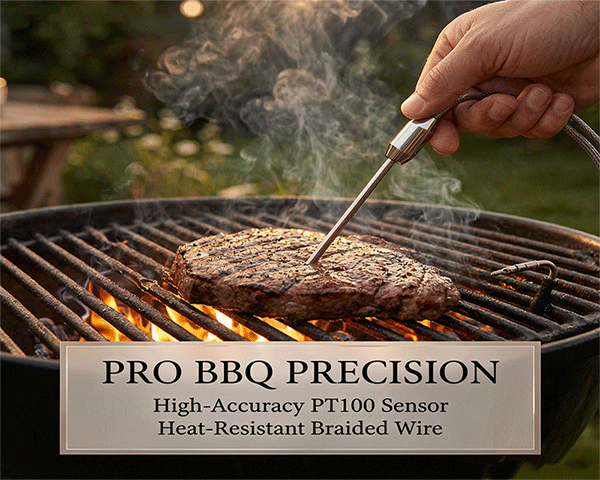
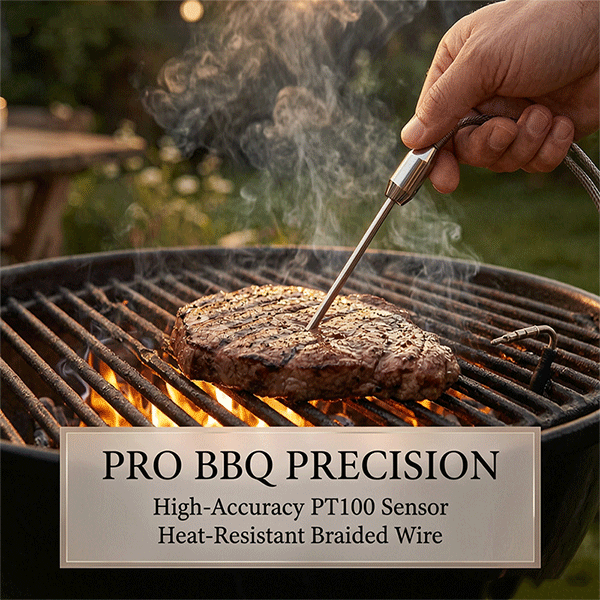
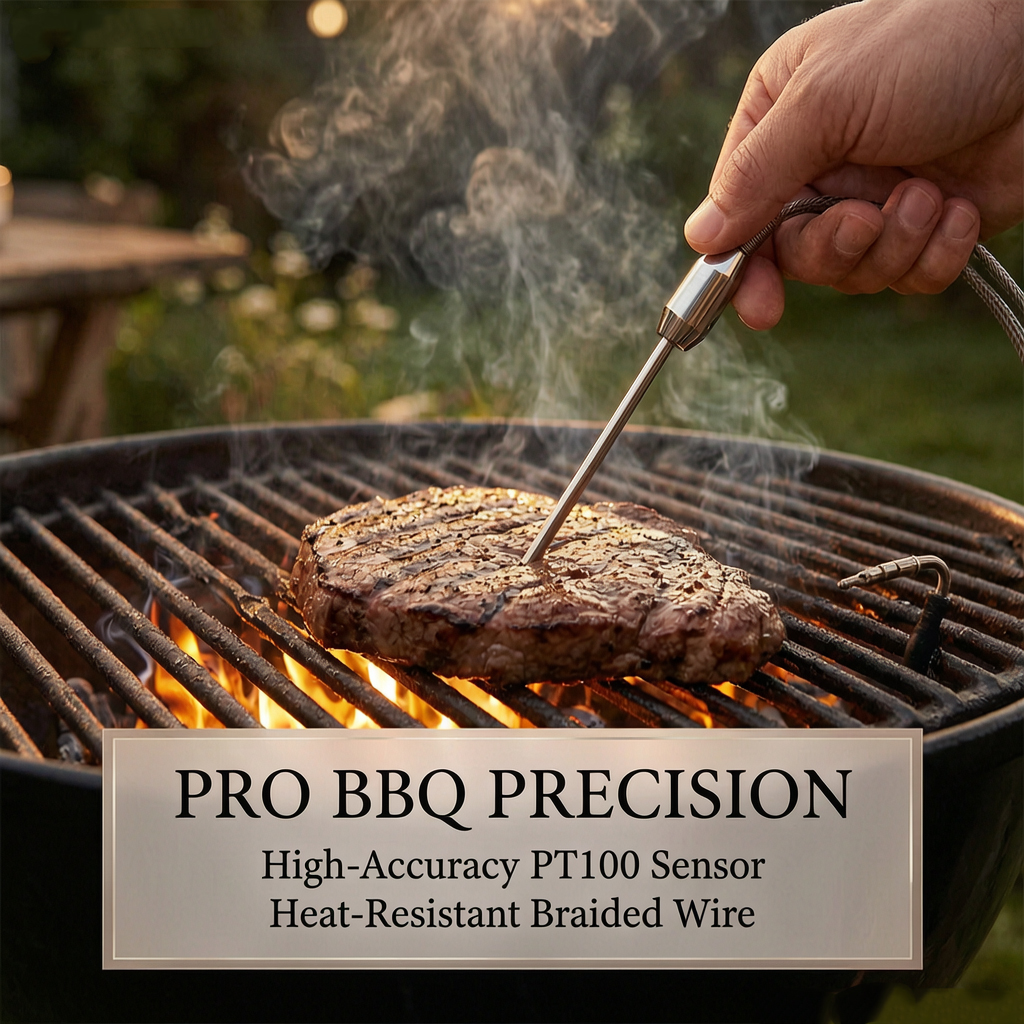
Direct insertion into the thickest part of the cut — the single reading that decides the cook.
Offset Smokers & Pellet Grills
Long cooks at 110–135 °C with a probe sitting in the meat for 12 hours. The braided jacket handles the radiant heat from the firebox side; the aluminium joint handles being moved between shelves.
Kamado & Ceramic Cookers
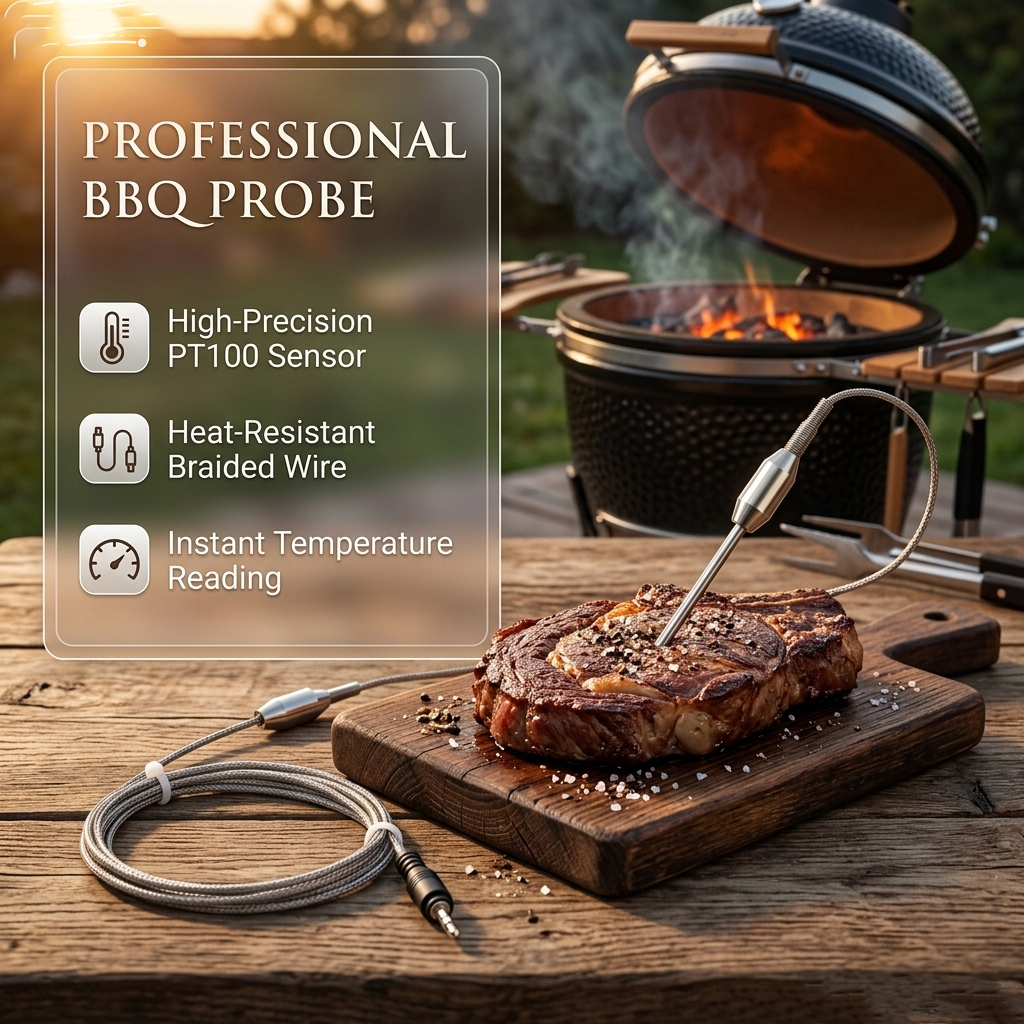
Direct radiant heat above 300 °C at the dome. Route the braided cable over the felt gasket, not across the fire ring, and the probe reads the point, not the flame.
Commercial Rotisserie & Charbroiler
Where probes are handled by staff rather than owners, the failure mode is always the joint. Machined aluminium and a moulded boot are the difference between a quarterly and a yearly replacement cycle.
Butchery & Food QA
HACCP temperature verification, cooling-curve logging and brine monitoring. Pt100 interchangeability means a second probe reads the same as the first — which is what an audit asks for.
Target Internal Temperatures, for Reference
Protein
Doneness
Pull at
Beef
Rare / medium rare / medium / well done
49–52 °C · 54–57 °C · 60–63 °C · 71 °C+
Lamb
Rare / medium / well done
52 °C · 60 °C · 71 °C
Pork
Medium / well done
63 °C (rest 3 min) · 71 °C
Poultry
Breast / thigh
74 °C · 80–85 °C
Fish
Flaking / firm
55–60 °C · 62–65 °C
Brisket
Probe-tender
95–96 °C
Pulled pork
Bone slides clean
90–95 °C
Carry-over cooking adds 3–5 °C during rest. Pull 3 °C below target for large cuts.
Kamado work: probe in the point, braided cable routed over the gasket — never across the fire ring.
OEM & Customisation
Make It Your Probe
We build this probe for grill brands, thermometer brands and distributors, not only as a catalogue item. Changes are handled at the drawing stage, so the price impact stays small and the lead time stays predictable.
Shaft — length 50–300 mm, diameter 4/5/6 mm, pointed or rounded tip
Cable — 0.5 m to 5 m, braided stainless or high-temp silicone, straight or coiled
Connector — 2.5 mm or 3.5 mm mono, bare wire, ferrule, M12, or your own mould
Wiring — 2-wire, 3-wire or 4-wire; Pt100, Pt1000 or NTC on the same body
Documentation — calibration certificate, material certificate, RoHS / REACH declaration
Trial orders welcome. Tell us the shaft length, cable length and connector you need, and we will quote against your specification — samples can be built before you commit to a production run.
FAQ
Questions Buyers Ask Before Ordering
Will this probe work with my existing BBQ thermometer?
Only if that unit accepts a Pt100 input. Consumer thermometers that use 10 kΩ or 100 kΩ NTC probes will not read this sensor correctly. Check the manual for "Pt100", "RTD" or "100 Ω at 0 °C" — or send us the model and we will confirm it for you.
What is the maximum temperature it can take?
300 °C continuous at the shaft and cable, with short excursions to 350 °C. A kamado sear zone can exceed that, so keep the braided cable off the fire ring and out of direct flame rather than relying on the rating.
Can it stay in the meat for the whole cook?
Yes — that is what it is built for. The shaft is sealed and the cable is rated for 300 °C, so a 14-hour brisket cook is well inside its envelope. Do not immerse the plug or the aluminium joint in water.
Why aluminium at the joint instead of plastic?
Because that is where probes break. Plastic ferrules creep and crack at smoker temperatures, and all the bending load lands on the conductors. A machined alloy body carries that load and keeps the seal intact.
How should I clean it?
Wipe the shaft with warm water and a mild detergent, then dry. A nylon scouring pad is fine on 316L. Avoid dishwashers, chlorine bleach and soaking the joint or plug — none of those are good for a resistance sensor.
Can I order a custom length or connector?
Yes. Shaft 50–300 mm, cable 0.5–5 m, and 2.5 mm / 3.5 mm / bare wire / ferrule / M12 connectors are all available. Send a drawing or a sample and we will match it.
Do you supply calibration or material certificates?
Yes, on request with each order — a calibration certificate traceable to the Pt100 tolerance class, plus 316L material certification and RoHS / REACH declarations for retail compliance.
Send us your shaft length, cable length and connector. We will confirm the Pt100 configuration, quote against your volume and build samples before production.
Have questions? Need a quote? We are ready to help! Fill out the form and a member of our sales team will contact you to discuss your requirements. You can also give us a call at (86)177-9158-1665.